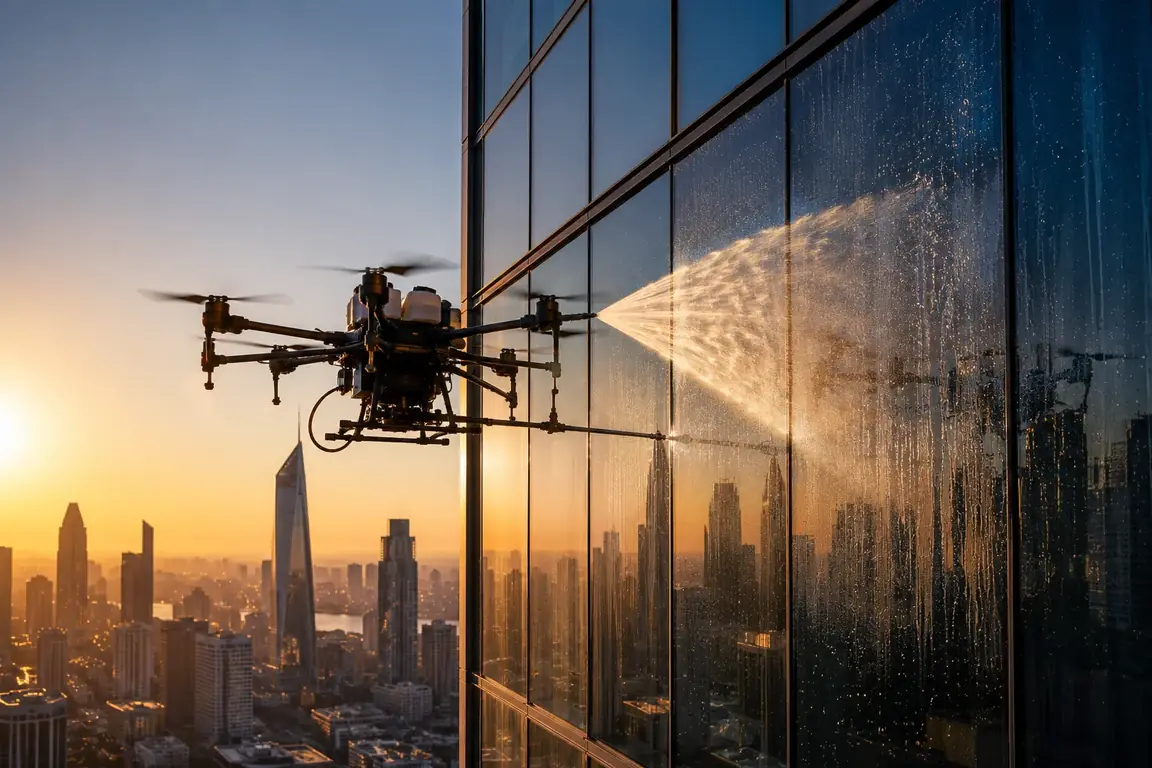
Quick answer: Cleaning drones are tethered to a ground pump and spray water or cleaning solution onto a surface. They're best suited to soft washing large, open, robust surfaces, such as roofs, render, cladding and some glass, where no agitation is needed and the site allows flying. Rope access cleaning puts a person at the surface with brushes and hand tools. It's better for ingrained dirt, detail, delicate materials, stone, bird fouling and anything that needs inspecting at the same time, and it isn't limited by drone flight rules. In dense central London, flight permissions, people below and spray drift often limit what drones can do.
Comparison
| Drone cleaning | Rope access cleaning | |
|---|---|---|
| Method | Tethered spray (water/solution), no physical contact | Brushes, pure-water poles, hand tools; direct contact |
| Best for | Soft washing large open surfaces; roofs; algae | Glass, frames, cladding, stone, detailed façades, fouling |
| Ingrained dirt | Limited (no agitation) | ✅ |
| Delicate materials (stone, heritage) | ⚠️ Risky without trials | ✅ With trial panel |
| Inspection at the same time | Photos only | ✅ Hands-on defect check |
| Spray drift | Higher risk near people and cars | Lower; controlled |
| Chemical run-off | Needs control | Needs control |
| London restrictions | CAA permissions, FRZs, people below, landowner consent | Exclusion zones; anchors |
| Set-up | Fast where flight is allowed | Fast where anchors are in date |
Questions to ask a drone cleaning provider
- What CAA authorisation do you hold for this location?
- How will you manage people, vehicles and spray drift below?
- What products will you use, and how will run-off be handled?
- Has the method been trialled on this material?
- What insurance covers the work?
- What happens to ingrained dirt or detail the spray doesn't remove?
When rope access is the better choice
- Glass and frames where a streak-free finish is needed.
- Stone, brick and terracotta needing gentle, controlled methods (BS 8221-1).
- Busy pavements and entrances where spray drift is unacceptable.
- When you want defects found and reported during the clean.
- Light wells, courtyards and set-backs.
FAQ
Can drones clean windows?
They can spray glass, but without agitation the result may not match traditional or pure-water brush cleaning, especially on dirty glass.
Is drone cleaning cheaper?
On large, open, simple surfaces where flight is permitted, it can be. On complex or central London sites, permissions and limitations often erode that advantage.
Is drone cleaning legal in London?
It's regulated by the CAA. Commercial operations need the right authorisations and permissions for the specific location.
Get the right cleaning method
See our façade cleaning and services, or request a site survey.
Sources
- Civil Aviation Authority, UK drone regulations.
- BS 8221-1:2019.


