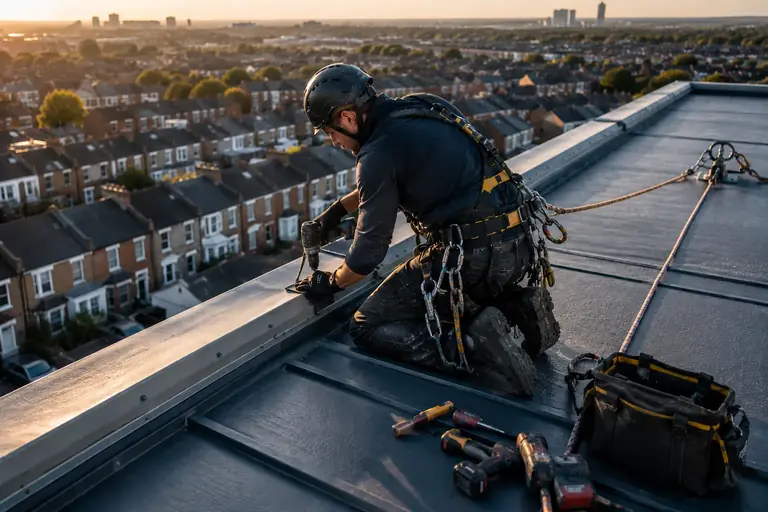
Quick answer: Dirt hides defects. When a façade is cleaned, especially up close by rope access, technicians often uncover hairline cracks, open joints, failed sealant, rust staining, hollow render, spalled concrete, failed earlier repairs and loose fixings. None of these will be fixed by cleaning, and some get worse if they're ignored or pressure-washed. The smart approach is to clean and inspect in the same visit, photograph what's found, and scope repairs straight away, ideally before winter.
8 defects cleaning often reveals
| # | Defect | Why cleaning reveals it | What to do |
|---|---|---|---|
| 1 | Hairline and stepped cracks | Soiling fills and hides fine cracks | Measure, photograph, monitor; investigate if wide or growing |
| 2 | Open or eroded mortar joints | Dirt crust masks missing pointing | Re-point with a compatible mortar |
| 3 | Failed sealant | Grime hides adhesion loss | Cut out and re-seal |
| 4 | Rust staining | Clean stone makes iron staining obvious | Investigate corroding cramps, fixings or reinforcement |
| 5 | Hollow or debonded render | Technicians tap and touch while cleaning | Tap-test, mark up and repair |
| 6 | Spalling concrete | Loose fragments come away during cleaning | Make safe; concrete repair |
| 7 | Old repairs failing | Mismatched mortar and patching become visible | Replace with compatible repairs |
| 8 | Loose fixings and attachments | Hands-on contact with brackets and redundant fixings | Secure or remove |
Why you should never "just clean"
- Pressure washing can force water through open joints and failed sealant into the building.
- Cleaning can make a building look sound while defects carry on growing.
- If something falls later, a recent clean with no record of defects is hard to explain.
Turn the clean into an inspection
Ask your cleaning contractor to:
- photograph and reference any defect they see (elevation, level, drop);
- flag urgent items the same day;
- make safe anything loose, within agreed limits;
- include a short defect list with the cleaning report.
Because the team is already at arm's length from the façade, the extra cost is small, and it often avoids a separate inspection visit.
When to call in a specialist
- Cracks wider than about 5 mm, or cracks that are growing → structural engineer.
- Widespread rust staining in stone or concrete → building surveyor or engineer to investigate fixings and reinforcement.
- Leaks → staged leak investigation (see façade leak investigation).
- Listed buildings → conservation-accredited professional.
FAQ
Should repairs be done before or after cleaning?
Usually clean first to reveal defects, then repair, then a light final clean of the repaired areas if needed. Make-safes happen immediately.
Will cleaning make cracks worse?
Gentle methods won't. High pressure can open joints and drive water in, which is another reason to avoid it on masonry.
Can the same contractor clean and repair?
Often, yes, if they have the trade skills. It saves a second mobilisation. Check their competence for each repair type.
Clean and inspect in one visit
See our façade cleaning and building maintenance, or request a site survey.
Sources
- BS 8221-1 and BS 8221-2 (cleaning and surface repair of buildings).
- BRE Digest 251 (crack-width assessment).