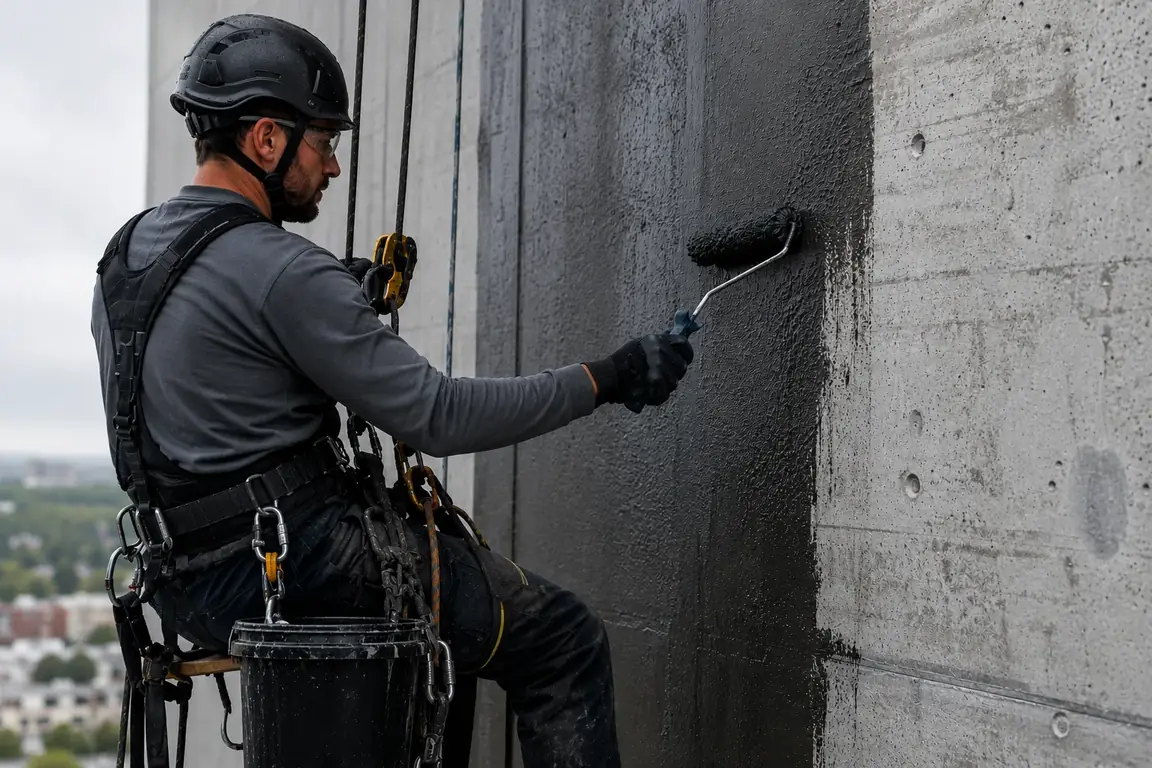
Quick answer: Don't just re-seal the nearest joint. Water often enters the façade metres away from where it appears inside. A proper investigation has four steps: (1) keep a leak diary that matches each leak to the rain and wind direction, (2) carry out a close-access inspection of the likely entry routes above and to the windward side, (3) water-test suspect areas one at a time, working from the bottom up, until the leak is reproduced, and (4) repair, then re-test to prove the fix. Done in that order, you pay to fix the cause once instead of paying to guess repeatedly.
First 48 hours: what to do right now
- Protect the inside. Move equipment, put down containment, and isolate electrics if water is near them.
- Photograph everything: the stain, drip point, ceiling tile and window. Note the exact location (floor, grid or bay, elevation).
- Start a leak diary (template below).
- Tell your insurer and, if relevant, the landlord or tenant. Early notice protects claims.
- Don't let anyone "just mastic over it" before the source is found. Covering up the evidence makes the investigation harder and more expensive.
The leak diary: the cheapest diagnostic tool there is
| Date/time leak seen | Location inside | Rain (light/heavy/storm) | Wind direction & strength | How long after rain started? | Photo ref |
|---|---|---|---|---|---|
Wind direction comes from Met Office records for your area. Patterns tell investigators a lot:
- Leaks only in wind-driven rain from one direction point to that elevation's joints, gaskets or flashings.
- Leaks hours after rain stops suggest water tracking through a cavity, or a blocked roof or gutter outlet backing up.
- Leaks in any rain suggest a direct defect, such as an open joint, a failed seal or a cracked coping.
Why the leak isn't where the water appears
Water enters at one point and then travels: along cavity trays, down mullions, across the tops of lintels and through service penetrations. Common entry points on London commercial buildings include:
- Failed perimeter sealant around windows and panels;
- Gaskets in curtain walling that have shrunk or slipped;
- Parapets and copings: open joints, failed cappings, low upstands;
- Roof-to-wall junctions and flashings;
- Penetrations: balustrade fixings, signage brackets, vents, cable entries;
- Blocked drainage: gutters, outlets, curtain wall drainage slots.
How a professional investigation works
| Stage | What happens | Output |
|---|---|---|
| 1. Desk review | Leak diary, drawings, O&M manual, previous repairs | Shortlist of likely entry zones |
| 2. Internal inspection | Moisture meter readings, thermal imaging where useful, lifting ceiling tiles | Map of where water reaches inside |
| 3. Close-access external inspection | Rope access technicians inspect the shortlisted zones within arm's reach: joints, gaskets, fixings, copings | Photo-referenced defect list |
| 4. Water testing | Controlled spray testing of one area at a time, starting low and working up, with someone inside watching. Curtain walling can be site-tested to BS EN 13051. | The confirmed entry point(s) |
| 5. Repair | Targeted repair of the confirmed cause | Completed work with photos |
| 6. Re-test | The same test repeated on the repaired area | Proof the leak is fixed |
The bottom-up order matters. If you spray high first, water runs down over lower joints, and you can't tell which one let it in.
Why rope access suits leak investigations
- Technicians can get within arm's reach of any joint, at any height, without scaffolding the whole elevation.
- The same team can inspect, test, repair and re-test in one mobilisation.
- Tenants stay in. There's no scaffold blocking light or entrances while you wait for a diagnosis.
When you need more than a contractor
Bring in a façade engineer or building surveyor if the leak points to a design or system problem rather than a maintenance defect. Signs include multiple leaks across the building, issues with the curtain-wall system itself, a building still within its warranty or defects period, or a likely dispute or claim. A good contractor will tell you when you've reached that point.
FAQ
How much does a façade leak investigation cost?
It depends on how many areas need testing. We quote after a survey, based on how many areas need testing. See what affects a rope access quote.
Can you find a leak when it isn't raining?
Yes. That's what water testing is for. Testing in dry weather is often better, because natural rain isn't confusing the results.
Can't we just re-seal all the windows?
You could, but it's expensive, and if the water is getting in through a coping, gasket or penetration, the leak will continue. Find the source first.
How long does it take?
We'll confirm the time on site and when you'll receive the report with the quote.
Get the leak traced properly
Send your leak diary and photos. Even a partial diary helps. Read about our waterproofing and leak repair and building maintenance, or book a leak investigation.
Sources
- BS EN 13051, Curtain walling: watertightness, site test.
- Met Office, historic weather observations (for the leak diary).


