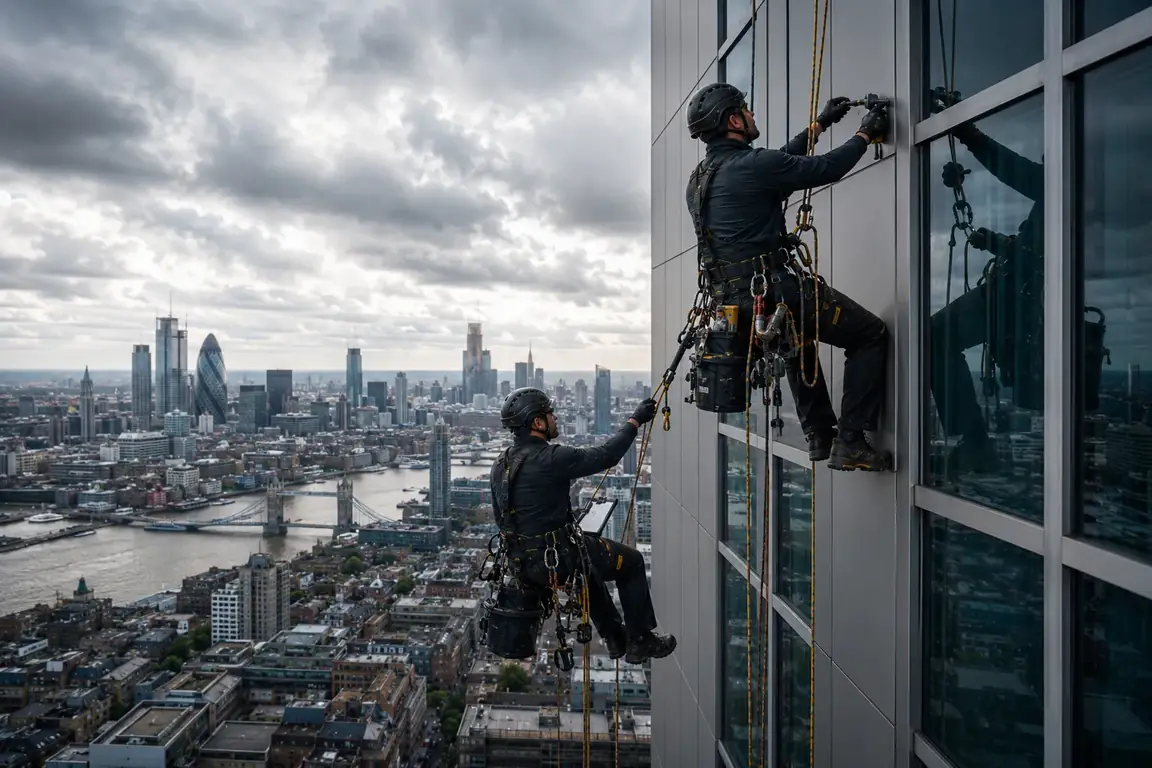
Quick answer: Most rope access work is priced per team-day. A team is normally at least two IRATA technicians, with a Level 3 supervisor responsible for the site. One published London guide puts a two-person team at around £300–£500 per day, with complex central London work above that. This is an indicative market figure as at November 2026 (see Sources), not a Vertical Heights price or a quote. Your actual price depends mostly on how many days the work takes, which in turn depends on the seven factors below.
These are general guides, not quotes. We give a fixed price after a site survey.
Typical prices
| Job type | What's usually included | How it's usually priced |
|---|---|---|
| Two-person rope access team | Day on site, access equipment, Level 3 supervision | Per team-day |
| High-level inspection with photo report | Close visual inspection of agreed drops, annotated photos, defect list | Fixed price for the agreed drops |
| Leak investigation | Inspection of the suspected area, targeted checks, findings report | Fixed price per area investigated |
| Sealant/mastic replacement | Cut out, prepare, re-seal | Per linear metre, or day rate |
| Façade or high-level window clean | Per visit, depending on area and material | Per visit, or per programme |
| Gutter clearance (high level) | Clear, flush, photos | Per visit |
For context: a published London guide (see Sources) quotes two-person rope access teams from around £300–£500 per day, as an indicative market figure that may since have changed. Complex central London commercial work, specialist trades and out-of-hours working sit above that. Scaffolding for the same tasks typically adds an erect-and-dismantle charge, weekly hire and a council highway licence before any work starts. See rope access vs scaffolding.
The 7 factors that move your quote
1. Number of drops (the biggest driver)
A "drop" is one vertical run of rope from the roof to the ground. Each new drop means de-rigging, moving and re-rigging, which commonly takes 20–60 minutes depending on the anchorage. Twenty defects spread across 20 drops cost far more than twenty defects in one drop. Cut the cost: group work by elevation, and combine tasks so each drop is used once.
2. Anchorage
Certified permanent anchors, in date for BS 7883 inspection, are the cheapest starting point. With no usable anchors, the team may need counterweight systems, structural anchoring to plant or steel, or temporary anchors, all of which add time and sometimes equipment hire. Cut the cost: send your most recent anchor test certificate with the enquiry.
3. The task itself
Cleaning glass is quick, while cutting out and re-sealing joints is slow. Material costs, such as sealant, coatings, replacement panels and bird-proofing, are added on top of labour.
4. Ground-level management
Busy entrances, bus stops and shopfronts may need larger exclusion zones, an extra ground person, early starts or weekend work. Out-of-hours rates are typically higher.
5. Height and access to the roof
Height itself matters less than you'd think, because a 30 m drop takes little longer to rig than a 15 m drop. What costs time is getting to the roof: restricted lifts, long carries of kit, roof permits and key-holder arrangements.
6. Weather and time of year
Rope access stops in high wind and some tasks, such as sealant and coatings, need dry conditions within set temperature limits. Winter work carries more weather risk. Ask how weather days are charged.
7. Reporting and paperwork
A photo summary is quick. A full condition report with defect referencing, drawings mark-up and recommendations takes office time and is priced accordingly. RAMS, permits and CDM documentation are normally included, but check.
How to get an accurate quote fast
Send:
- the address and photos of the affected areas, both close-up and wide;
- elevation drawings if you have them;
- the last anchor test certificate;
- site constraints, such as working hours, entrances and loading bays;
- what you need at the end: the work only, or work plus a report.
With that information, a simple job can often be priced from photos. Anything larger should be surveyed. A survey protects you from variations later.
How to compare quotes
| Check | Why it matters |
|---|---|
| Same drops and areas | The most common reason one quote is cheaper |
| Materials included? | Some quote labour only |
| Weather days | Who pays if the team can't work? |
| Out-of-hours | Is it included or extra? |
| Reporting | Photos only, or a full report? |
| Variations | What rate applies if more defects are found? |
FAQ
Is rope access cheaper than scaffolding?
For short, targeted work on taller buildings, usually yes, often by a wide margin, because there's no erection, hire or licence cost. For long programmes covering a whole elevation, scaffolding can work out cheaper.
Can I get a price from photos?
For straightforward tasks, often yes, with stated assumptions. For leaks, defects or large areas, a survey gives you a firm price and avoids surprises.
Get a fixed price
Send photos and the address, and we'll come back with either a price or a survey date . See our rope access in London and building maintenance services, or request your quote.
Sources
- London Professional Abseiling, The future of rope access in London: two-person team day-rate range (indicative market figure, not a quote).
- BestBuilders, Scaffolding hire cost per week 2026: scaffold and licence ranges.
- BS 7883:2019 (anchor inspection).


