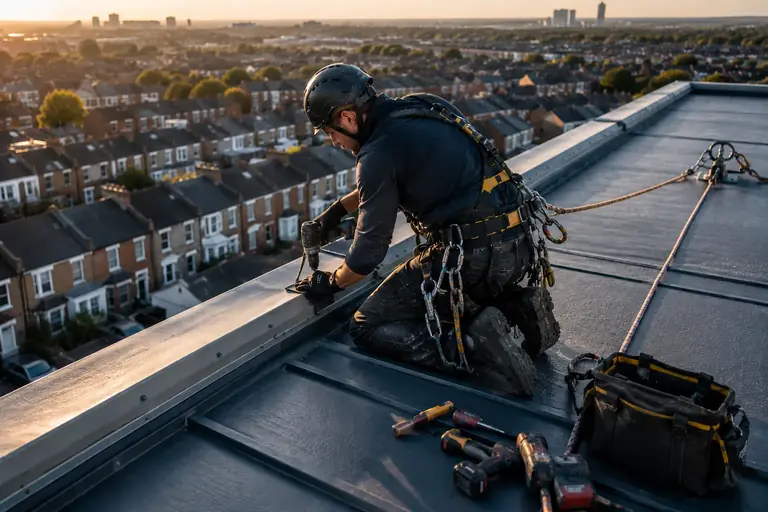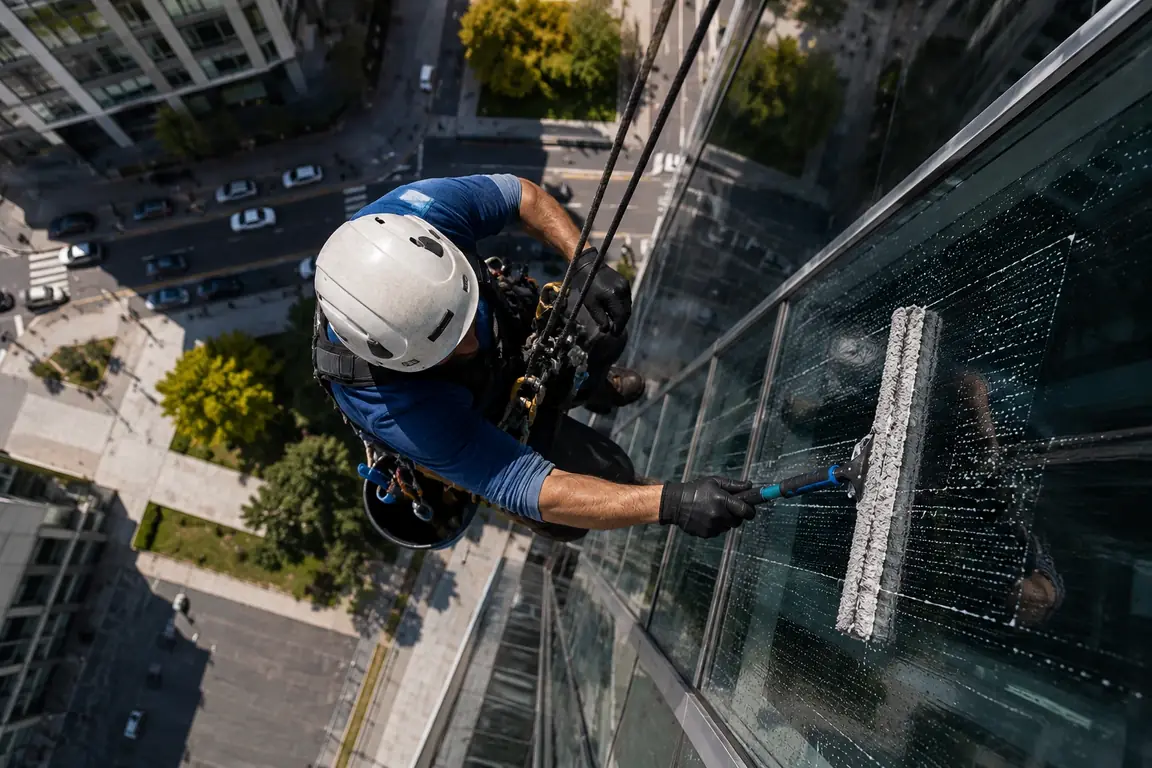
Quick answer: Rope access is the right choice when the work is short-duration, spread across a tall or awkward façade, and light enough to carry. Typical examples are inspection, cleaning, sealant, glazing repairs, gutter clearance, bird proofing, small fabric repairs, signage and make-safes. It's the wrong choice when the work needs a fixed platform for weeks, heavy materials or many trades at once, as with full re-cladding, re-rendering or major masonry rebuilds.
Task-by-task suitability
| Task | Rope access? | Notes |
|---|---|---|
| Close-access façade inspection | ✅ Ideal | Arm's-length access to every point on a drop |
| Window and façade cleaning | ✅ Ideal | Especially where there's no BMU, or the BMU can't reach |
| Sealant / mastic replacement | ✅ Ideal | Work is linear and spread out, which is exactly what ropes do well |
| Leak investigation and water testing | ✅ Ideal | Inspect, test, repair and re-test in one mobilisation |
| Gutter, outlet and downpipe clearance | ✅ Ideal | No scaffold or road closure needed |
| Bird proofing (netting, spikes) | ✅ Ideal | |
| Glazing gasket and small panel replacement | ✅ Usually | Larger glass units may need lifting equipment |
| Concrete or stone patch repairs | ✅ Usually | Small areas. Large areas favour a fixed platform. |
| External painting | ⚠️ Sometimes | Good for stairwells, towers and parts of elevations. A full repaint of a large building may suit scaffold. |
| Signage install or replacement | ⚠️ Sometimes | Depends on weight. May combine ropes with a hoist. |
| Re-cladding or full re-rendering | ❌ Rarely | Needs a continuous platform and heavy material handling |
| Structural masonry rebuild | ❌ Rarely | Heavy, long-duration and multi-trade |
The four questions that decide it
- Can the work be done by one or two people with hand tools and light materials? If yes, rope access is likely.
- Is the work spread out rather than concentrated in one large area? Spread-out work favours rope access.
- Will people be at height for days rather than weeks? Days favour rope access.
- Is there safe anchorage on the roof, or can it be provided? Certified permanent anchors make rope access simple. Without them, the team may need a counterweight system or anchors on suitable structure.
If the answer to all four is yes, rope access will usually be quicker, cheaper and less disruptive than the alternatives.
Where rope access struggles
- Heavy or bulky materials, such as large glass units or stone blocks, unless a separate lifting arrangement is planned.
- Tasks needing both hands and a stable bench for long periods, such as some specialist coating systems.
- Exposed sites in persistent high wind, where weather days add up.
- Buildings with no anchorage and no suitable structure, where providing it costs more than the job.
What the law expects
Under the Work at Height Regulations 2005, rope access is a legitimate method where a risk assessment shows that other, collective measures aren't justified because the work is short or because of site features. In practice, that covers most of the "ideal" rows above. The contractor should record this reasoning in the RAMS. The work itself is normally carried out to the IRATA International Code of Practice, under a Level 3 supervisor.
Combining methods
You don't have to choose just one. Common combinations include:
- a MEWP for the ground and first floors, with rope access above;
- rope access to inspect and scope, then scaffold only for the zone that needs heavy repair;
- rope access to reach areas a BMU can't.
FAQ
Is rope access only for tall buildings?
No. It's also used on low buildings with awkward access, such as over canopies, conservatories, railways or water, or where a scaffold or machine can't be positioned.
How quickly can rope access start?
Once the survey and RAMS are done, rigging usually takes hours, so work often starts on the first day on site.
Can rope access handle heavy items?
Only light to moderate loads by hand. Heavier items need a planned lifting system or a different access method.
Check your job
Send us photos and a short description, and we'll tell you honestly whether rope access fits. See our rope access in London and services, or request a site survey. Related: rope access vs scaffolding and rope access vs MEWP.
Sources
- Work at Height Regulations 2005 (incl. Schedule 6, rope access requirements).
- IRATA International Code of Practice (ICOP).