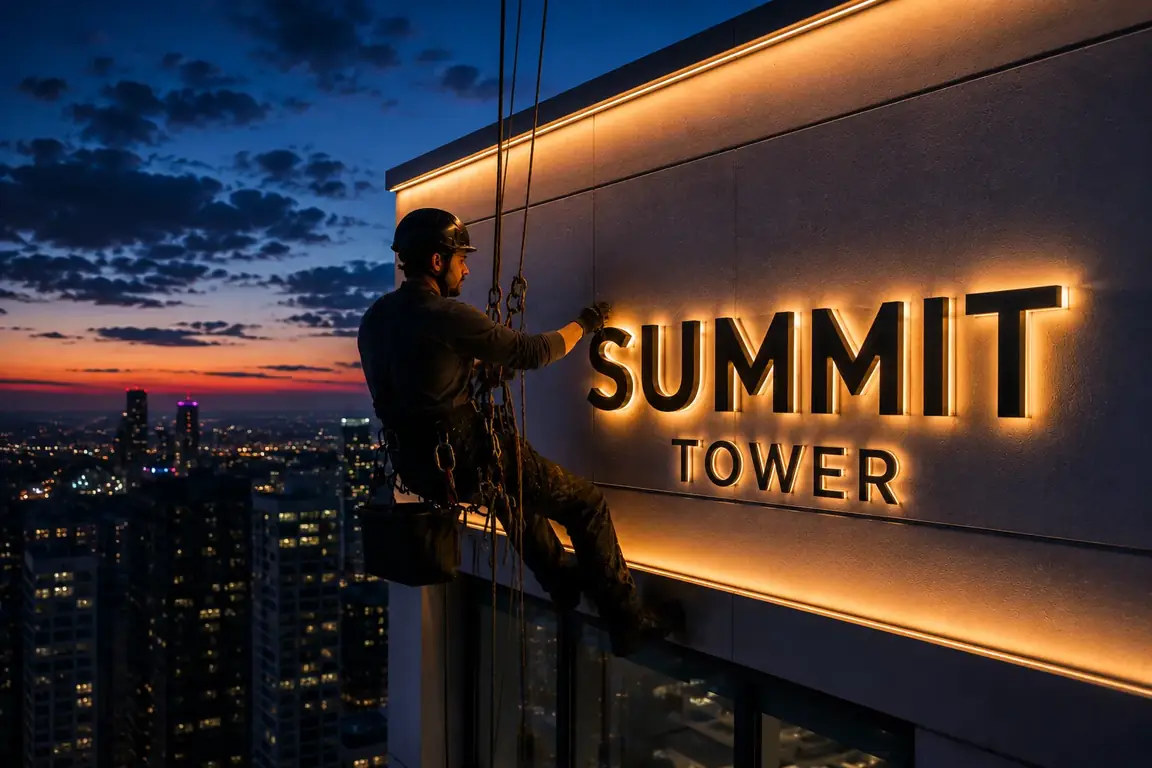
Quick answer: A MEWP, such as a cherry picker, boom lift or scissor lift, is usually the better choice for low to mid-height work where a machine can park close to the building on firm, level ground. Rope access is usually better when the building is taller than a machine can reasonably reach, when the work is behind setbacks, canopies, atria or courtyards, or when parking a large vehicle on a London street would mean road closures, licences and disruption. Many jobs use both: a MEWP for the lower levels and rope access above.
Side-by-side comparison
| MEWP (cherry picker / boom / scissor) | Rope access | |
|---|---|---|
| Reach | Common truck-mounts reach roughly 20–45 m. Specialist machines go higher but are costly and need a lot of space. | Effectively unlimited height wherever safe anchorage exists |
| Ground needs | Firm, level ground able to take outrigger loads. Often a road or pavement lane. | A small exclusion zone below the work. No vehicle needed. |
| Awkward geometry | Struggles with podiums, canopies, set-back upper floors and internal courtyards | Works around overhangs, recesses and internal light wells |
| Licences (London) | A machine on the highway usually needs a council licence or permit and often a parking suspension | Usually no highway structure licence. Pavement controls are still planned. |
| Wind | Machines have a manufacturer's maximum wind speed, commonly 12.5 m/s for outdoor platforms | Work is also stopped in high wind, at a level set in the RAMS |
| Operator competence | Trained operator, typically holding an IPAF PAL card | IRATA-certified team supervised by a Level 3 technician |
| Statutory checks | MEWPs that lift people need a LOLER thorough examination at least every 6 months | Rope access equipment is inspected to LOLER and the IRATA ICOP |
| Typical cost basis | Daily hire. Operated truck-mounts are widely quoted from around £370–£400/day nationally, with large machines and London delivery costing more. | Team-day rate, with no machine hire or delivery |
When a MEWP is the better tool
- Low-rise work, roughly 2–4 storeys, with a clear hardstanding or car park right next to the façade.
- Work in one place that needs a stable platform and both hands for long periods, such as installing heavier fittings.
- Sites where anchorage isn't available on the roof and installing temporary anchorage would cost more than hiring a machine.
- Internal atria with a flat floor that can take the load, where a spider lift or scissor lift is often ideal.
When rope access is the better tool
- Above the machine's practical reach, or where reaching would need an oversized truck-mount blocking the road.
- Narrow central London streets where a vehicle needs a road closure, a bus route diversion or out-of-hours working.
- Set-back or stepped façades, podium roofs, canopies, or glazing above a busy entrance.
- Repeated short visits, such as quarterly cleaning, sealant repairs or inspections, where mobilising a machine each time adds up.
- Elevations facing railways, rivers or private land where a machine simply can't be positioned.
The hidden costs to check on a MEWP quote
- Delivery and collection, often charged separately, and higher in the Congestion Charge and ULEZ zones.
- Highway licence and parking suspensions, which have council lead times that can run to weeks.
- Traffic management, such as banksmen, barriers or a full lane closure.
- Weather days. If the wind is over the machine's limit, are you still paying for the hire?
- Operator. Is an operator included, or do you need your own trained operator?
Five questions to decide
- What is the highest point that needs work, and how far is it from where a machine could park?
- Is the ground firm enough to take the outrigger loads, and is it the public highway?
- Are there overhangs, canopies, trees, power lines or set-back floors in the way?
- Is there certified roof anchorage? If so, when was it last tested? (BS 7883 recommends anchors are inspected at least every 12 months.)
- How many visits a year will you need?
FAQ
Is a cherry picker cheaper than rope access?
For a single short task on a low building with free parking right next to it, often yes. On taller buildings, in central London streets, or for repeat work, rope access is frequently cheaper once licences, delivery and traffic management are included.
What height can a cherry picker reach?
Common hire truck-mounts reach roughly 20–45 m, and specialist machines go higher. Reach is about outreach as well as height: a 45 m machine parked 10 m from the building can't reach 45 m up the façade.
Can rope access work alongside a MEWP?
Yes. Splitting the elevation, with a MEWP for the lower floors and rope access above, is common and often the most cost-effective option.
Talk it through with us
Send photos of the elevation and the street outside, and we'll tell you which method makes sense. If a MEWP is the better option, we'll say so. See our rope access services in London and the full list of high-level services, or request a site survey.
Sources
- HSE, Working at height guidance; Lifting Operations and Lifting Equipment Regulations 1998 (LOLER).
- BS EN 280 (mobile elevating work platforms: design and wind rating).
- BS 7883:2019 (anchor systems: design, installation and inspection).
- IPAF, PAL card operator training.
- Checkatrade, Cherry picker hire cost: operated truck-mount day rates.


