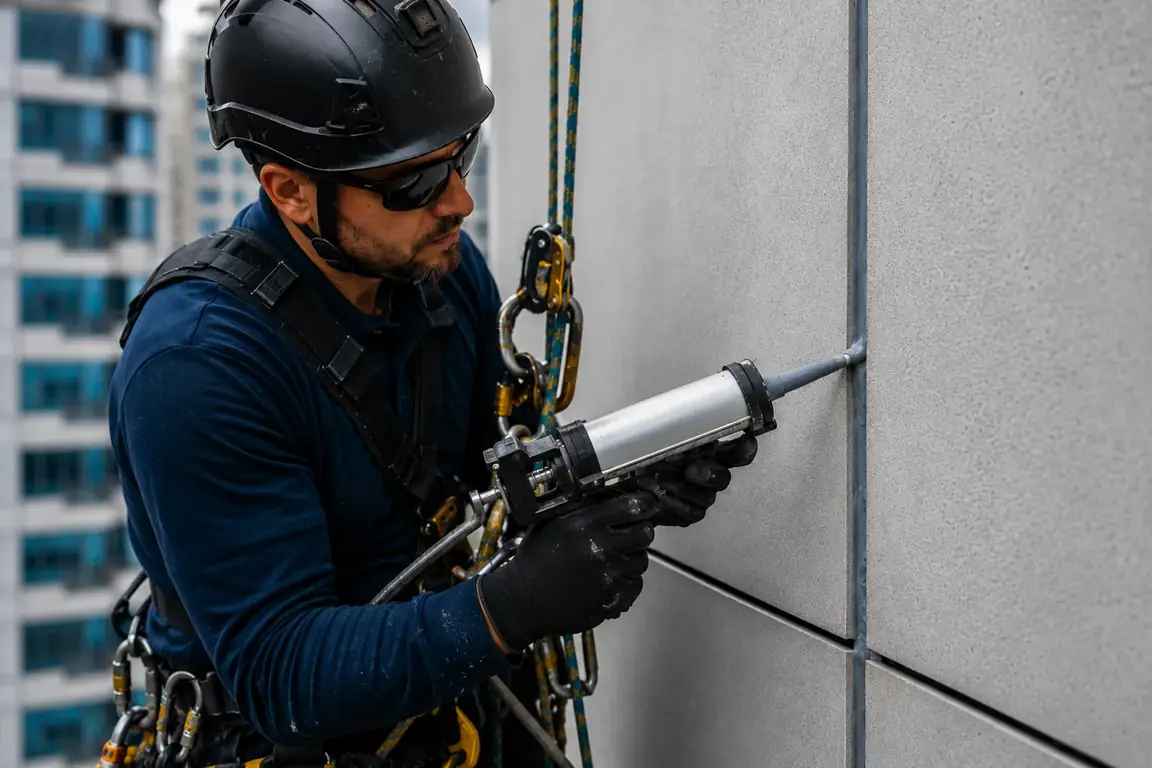
Quick answer: For short, targeted work on a tall or awkward London building, such as inspections, cleaning, sealant replacement, small repairs or signage, rope access is usually faster to start, cheaper and far less disruptive than scaffolding. A rope team can be working within hours of arriving. Scaffolding can take days to erect and needs a council licence if it touches the pavement. Scaffolding wins when lots of trades need the same area for weeks, when heavy materials are moved constantly, or when work covers the whole elevation, such as re-cladding or full re-rendering.
The rest of this guide sets out the trade-offs, typical costs and the questions that settle the decision for a particular building.
Rope access vs scaffolding at a glance
| Rope access | Scaffolding | |
|---|---|---|
| Time to start work on site | Typically the same day. Rigging takes hours. | Usually several days to erect, plus licence lead time. |
| Pavement footprint | A small exclusion zone below the work, moved as the team moves | A fixed structure, often with hoarding, fans and lighting |
| Council licence | Not normally needed for the structure. Pavement controls may still be needed. | A scaffold or hoarding licence is needed for anything on or over the public highway (Highways Act 1980, s.169). |
| Security | No climbable structure left overnight | Needs alarms or monitoring. Scaffolds are a known route for break-ins. |
| Natural light and tenant impact | Windows clear between drops | Netting and boards darken offices for the full hire period |
| Best for | Inspection, cleaning, sealant, small repairs, glazing, signage, bird proofing | Re-cladding, full re-rendering, heavy or repeated material handling, multi-trade programmes |
| Weak spots | Heavy loads, long continuous tasks needing a fixed bench, wind | Cost and time on tall buildings, licences, visual impact, disruption |
Why time and cost differ so much in London
Scaffold costs rise steeply with height and with London's operating conditions. Published UK guides put weekly extension hire on a large domestic wrap at roughly £130–£260 per week, after an erect-and-dismantle charge that often runs into thousands. London and the South East typically run 20–30% above northern rates. A highway licence adds £50–£400 in council fees, plus any parking suspensions, out-of-hours erection, fans and hoarding. On a commercial frontage several storeys high, the access alone can cost more than the work it supports.
Rope access is priced mainly by the team-day. You pay for the time the technicians spend on site, so the cost tracks the size of the job, not the size of the building.
Typical pricing approach at Vertical Heights: we give a fixed quote after a site survey, so the price reflects your building and the actual work.
When scaffolding can still work out cheaper
Rope access isn't automatically the cheaper option. Scaffolding can make more sense when:
- the programme runs for many weeks and several trades share the same face;
- large volumes of heavy material must be handled at height, such as full brick replacement or stone re-facing;
- the work needs a fixed, level working platform throughout, as with some render or coating systems;
- the building is low-rise, so a simple scaffold is cheap and quick.
What the law says about choosing the method
Under the Work at Height Regulations 2005, the duty holder must follow a hierarchy: avoid work at height where possible, then use equipment that prevents a fall, and only then equipment that minimises the distance and consequences of a fall. HSE summarises this as avoid, prevent, arrest. Scaffolding with guardrails is a collective "prevent" measure, while rope access is a personal fall-protection system. That doesn't rule rope access out. The Regulations allow it where a risk assessment shows that other work equipment isn't justified, given the short duration, the limited scope or features of the site. In practice, that describes most planned maintenance on tall London buildings.
What it means for you: a competent contractor should be able to explain why rope access is justified for your job and record that reasoning in the risk assessment and method statement (RAMS). Rope access work in the UK is normally carried out to the IRATA International Code of Practice (ICOP), with a Level 3 technician supervising.
Five questions that decide it for your building
- How much of the elevation needs work? Isolated defects, drops or zones favour rope access. Work across the whole face favours scaffold.
- How long will people be at height? Days favour rope access. Many weeks with several trades favour scaffold.
- What has to go up? Hand tools, sealant, cleaning kit and small panels suit ropes. Pallets of stone don't.
- What happens at ground level? Busy entrances, shop fronts, bus stops and narrow pavements push the decision towards rope access.
- What anchorage is there? Permanent roof anchors, davits or a suitable structure make rope access straightforward. If there's none, temporary anchorage or counterweight systems may be needed, and the survey will confirm this.
How to get comparable quotes
Ask both scaffold and rope access contractors to price the same scope: the same elevations, the same defects and the same deliverables (photos, report, warranty). Then compare:
- total access cost, including licences, hoarding, alarms and hire extensions;
- the realistic start date and how long the work will take;
- what stays open: entrances, parking, loading bays;
- who carries the weather risk, and how delays are charged.
FAQ
Is rope access safe compared with scaffolding?
Yes, when it's done properly. IRATA publishes industry safety data and rope access has a strong record. Each technician uses two independent ropes, a working line and a back-up line, and teams are led by a Level 3 supervisor with a rescue plan in place before anyone goes over the edge.
Is rope access always cheaper than scaffolding?
No. It's usually cheaper for short, targeted work on taller buildings and usually more expensive for long programmes covering a whole elevation. Compare total access cost against the same scope.
Do I need a scaffold licence for rope access?
Normally not, because there's no structure on the highway. You may still need to manage the pavement below, and some boroughs want to be notified or require a licence for barriers or temporary obstructions, so check with the contractor.
Can rope access and scaffolding be combined?
Yes. A common approach is a short scaffold or MEWP for the ground-floor zone, with rope access above.
Get a straight answer for your building
Send us the address, some photos and what you need done. We'll tell you honestly whether rope access is the right method, and if it isn't, we'll say so. You can read more about our rope access services in London and our building maintenance work, or request a free site survey.
Sources
- HSE, Working at height (construction guidance): hierarchy of controls.
- Work at Height Regulations 2005 (SI 2005/735).
- Highways Act 1980, s.169 (scaffold licences).
- IRATA International Code of Practice (ICOP).
- BestBuilders, Scaffolding hire cost per week 2026 (UK guide): UK scaffold cost and licence ranges.


