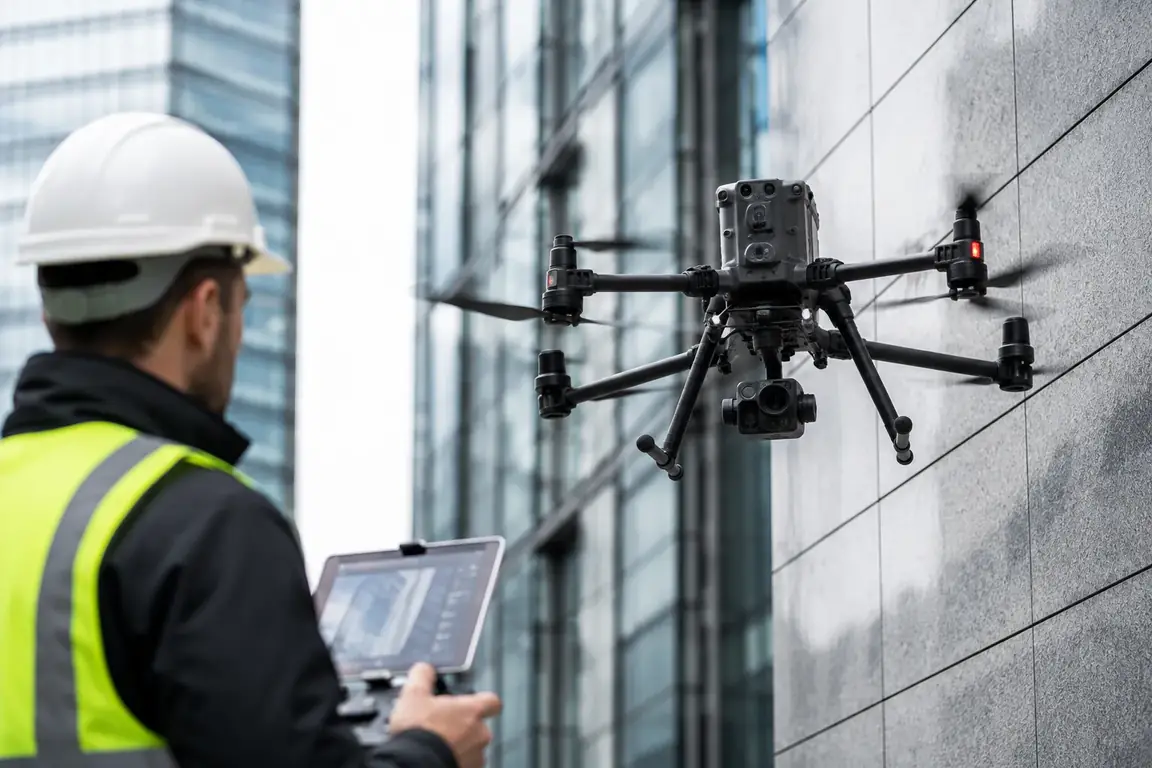
Quick answer: Drones are fast and cheap for overview imagery: whole elevations, roofs, hard-to-see areas, and a quick visual triage. Rope access is needed for evidence you can act on: tap testing, hand-checking fixings and sealant, measuring cracks, removing loose material and making small repairs. The best approach on many buildings is both: a drone to survey and target, then rope access to inspect and make safe the areas that matter. In central London, commercial drone flights also need the right CAA permissions and site permissions, which can limit where and when they fly.
Comparison
| Drone | Rope access | |
|---|---|---|
| Speed for overview | ✅ Very fast | Slower |
| Cost for a visual survey | ✅ Lower | Higher |
| Detail | High-res photos; thermal options | Arm's-length view, plus touch |
| Tap testing (hollow, loose material) | ❌ | ✅ |
| Fixings, cramps, sealant adhesion | ❌ | ✅ |
| Crack measurement | Estimated from images | ✅ Gauged |
| Make-safe on the day | ❌ | ✅ |
| Small repairs | ❌ | ✅ |
| Weather sensitivity | Wind, rain | Wind, rain |
| London restrictions | CAA rules on flying near people and buildings; airport Flight Restriction Zones; landowner permissions | Exclusion zones; anchors in date |
Drone rules in London (summary)
Commercial drone operations in the UK are regulated by the Civil Aviation Authority (CAA). In practice, in central London:
- flights near uninvolved people and in congested areas are tightly controlled, and commercial work often needs an Operational Authorisation in the CAA's Specific category;
- much of London sits within Flight Restriction Zones around Heathrow and London City airports, which need prior permission;
- landowner and building permissions are needed for take-off and landing;
- operators need the appropriate registration, competence and insurance.
Always check the operator's CAA credentials and insurance.
When to use which
| Goal | Best choice |
|---|---|
| Quick condition overview for budgeting | Drone |
| Post-storm triage of a large roof | Drone first, then rope access to the problems |
| Defect report you can repair from | Rope access |
| Insurance or legal evidence of a specific defect | Rope access (close-up, measured) |
| Loose material over a pavement | Rope access (make safe) |
| Thermal survey of roofs or façades | Drone (with thermal camera), with caveats |
FAQ
Is a drone inspection enough for an insurer?
It depends on what the insurer needs. For proving a specific defect, its extent and its cause, close-access inspection usually gives stronger evidence.
Are drone inspections cheaper?
For overview imagery, generally yes. For actionable defect reporting, you usually still need close access.
Can drones inspect inside light wells or atria?
Sometimes, but confined spaces, GPS shadow and nearby people make it harder. Rope access is often more practical there.
Need close-access evidence?
See our rope access in London and services, or request a site survey.
Sources
- Civil Aviation Authority, UK drone regulations (CAP 722 and related guidance).
- NATS / CAA, airport Flight Restriction Zones.


