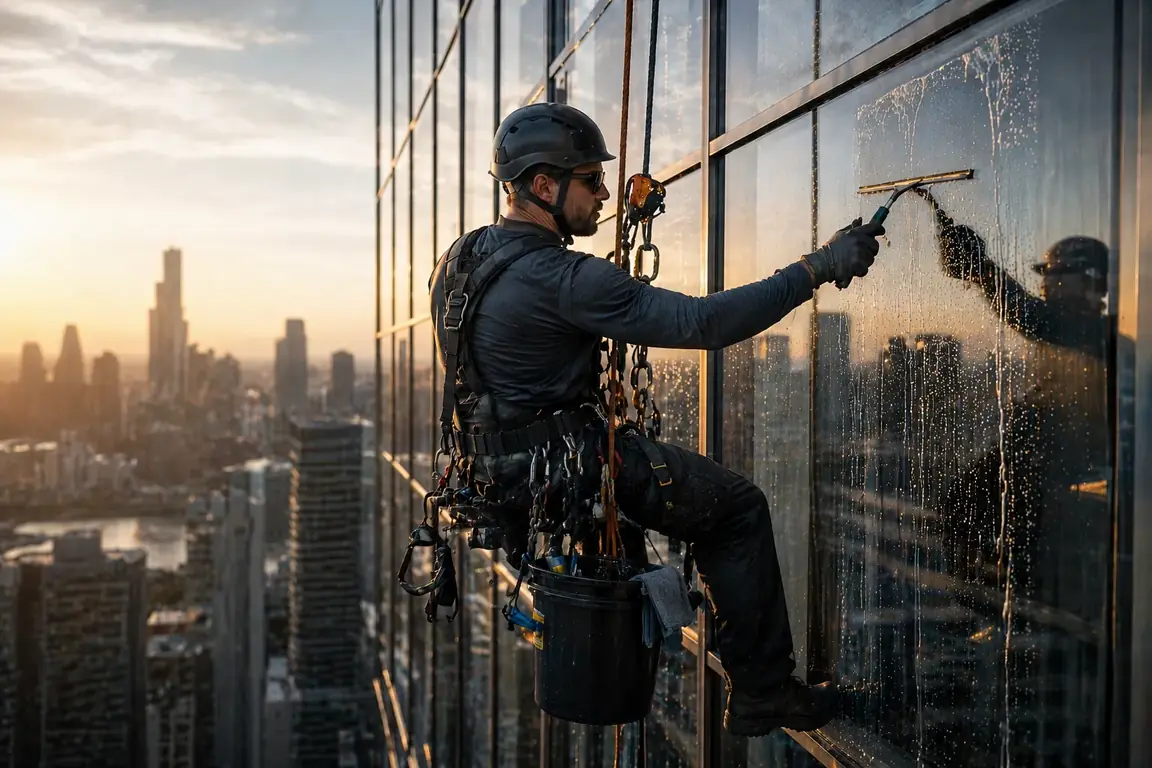
Quick answer: The main public risks from high-level cleaning are falling objects, water and spray drift, slippery pavements and people walking into the work area. They're controlled by an exclusion zone below every drop, tethering all tools and equipment, ground staff to manage pedestrians on busy frontages, clear signage, controlled water use and run-off, and stopping work in high wind. The Work at Height Regulations 2005 require measures to prevent falling objects from injuring anyone, and the exclusion zone is the last line of that protection.
The six controls
1. Exclusion zones
- A barriered area at the base of each drop, sized to the height and task. Wind can carry light objects well beyond the vertical.
- Moved as the team moves along the façade.
- On narrow pavements, pedestrians may need to be diverted, which can require coordination with the council if the highway is affected.
2. Tethered tools and equipment
- Every tool and bucket is attached to the technician or rope system.
- Equipment bags are secured. Nothing is placed loose on ledges.
3. Ground staff
- On busy frontages, entrances and bus stops, a dedicated ground person stops pedestrians walking under live drops and communicates with the team above.
4. Water, spray and slips
- Pure-water and low-pressure methods reduce drift and run-off compared with high-pressure washing.
- Work is paused when wind blows spray onto passers-by.
- Wet pavements are signed. In winter, watch for freezing run-off.
- Chemicals are kept away from drains and people.
5. Signage and information
- Signs at the edge of each zone: "Work overhead: do not enter".
- Notices in reception and lifts for building users.
6. Weather limits
- Work stops when wind exceeds the limit in the RAMS. Gusts are especially dangerous for lightweight equipment and spray.
- Lightning, heavy rain and ice are also stop conditions.
Special situations
| Situation | Extra controls |
|---|---|
| Main entrances & fire exits | Work these drops out of hours, or run escorted passage and covered routes |
| Outdoor seating (cafés, restaurants) | Agree times with the tenant; clear the seating area |
| Bus stops, crossings | Ground person; TfL or council coordination if affected |
| Car parks | Clear cars from the zone; spray drift can mark paintwork |
| Schools, hospitals | Strict timing and liaison |
Who's responsible?
The contractor plans and controls the work, including exclusion zones. The building owner or facilities manager should check the RAMS covers public areas, coordinate with tenants, and make sure entrances and fire routes are agreed. If the public highway is affected, the council may need to be involved.
FAQ
How big should an exclusion zone be?
It depends on height, task and wind. It's set in the RAMS for each drop. The aim is to keep people out of any area where something could land.
Can the pavement stay open?
Often, partly. Zones can be kept tight and moved quickly, and a ground person can manage flow. Full closures are rare for cleaning.
Is cleaning stopped if it's windy?
Yes, above the limits set in the RAMS. Rope access teams monitor wind on site.
Talk to us about your frontage
See our façade cleaning and rope access in London, or request a site survey.
Sources
- Work at Height Regulations 2005, regulation 10 (falling objects).
- HSE, Protecting the public: your next move (HSG151).
- Highways Act 1980 (obstruction of the highway).


