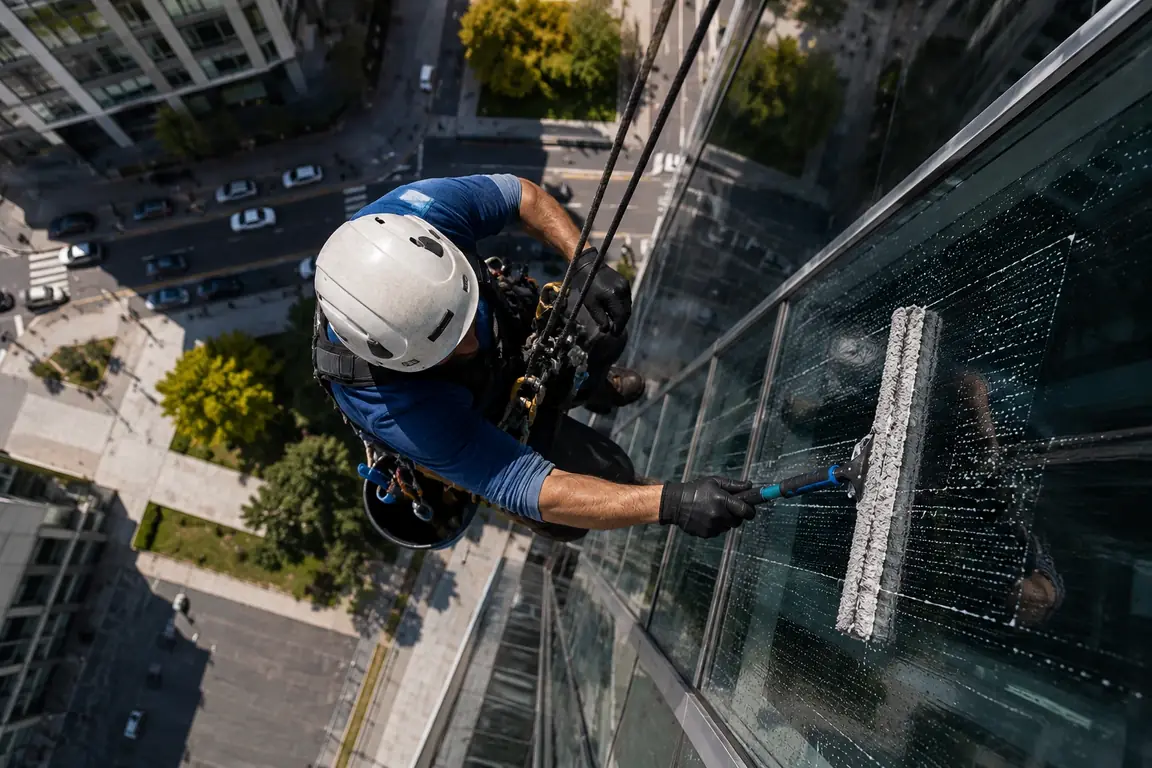
Quick answer: Most London high-rise offices clean external glass every 2–3 months. Hotels and prestige entrances need it more often, and residential towers typically every 3–4 months. The method depends on the building: a BMU (cradle) if one is installed and in date, rope access where there's no BMU or it can't reach, water-fed poles for roughly the lower 20 m, and MEWPs for low, open sites. Plan 2–4 weeks ahead, giving notice to tenants, booking roof access and confirming anchor or BMU certification, and agree a weather back-up date.
Which method suits your building?
| Method | Best for | Height | Watch-outs |
|---|---|---|---|
| Rope access (abseiling) | Any height, set-backs, irregular façades, buildings without a BMU | Unlimited where certified anchorage exists | Needs in-date anchors (BS 7883) and a ground exclusion zone |
| BMU / cradle | Buildings designed with one: large regular glass façades | Building-specific | Needs a LOLER thorough examination, typically every 6 months. A broken BMU stops the clean. |
| Water-fed pole (reach & wash) | Low to mid-rise, ground and podium levels | Up to roughly 18–20 m in practice | Struggles with deep reveals and heavy soiling. Needs pure water. |
| MEWP / cherry picker | Low-rise, open sites with hardstanding | Usually up to ~20–45 m | Road space, licences, delivery cost |
Many towers use a combination: water-fed poles for the podium, a BMU for the main façade, and rope access for areas the BMU can't reach, such as crowns, set-backs, canopies and atria.
Ladders are rarely suitable for commercial high-level cleaning. The Work at Height Regulations 2005 only allow them for low-risk, short-duration tasks where better equipment isn't justified.
How often?
| Building type | Typical external frequency |
|---|---|
| Corporate office | Every 2–3 months |
| Hotel | Every 1–2 months |
| Residential tower | Every 3–4 months |
| Mixed use | Monthly for retail and ground floor; quarterly for upper levels |
| Shopfronts / entrances | Weekly to fortnightly |
Busy roads, nearby construction and bird activity shorten these intervals. For cladding and stonework around the glass, see how often to clean commercial façades.
What does it cost?
Published UK guides put high-rise external cleans at roughly £500–£1,200 per visit for corporate offices and £700–£1,500 for hotels, and give a typical 12-storey London office budget of around £4,000–£6,000 a year for quarterly cleaning. Large glazed towers cost considerably more. The main cost drivers are the number of drops, access to the roof, how dirty the glass is, and whether frames and cladding are included.
The building manager's planning checklist
4 weeks before
- Confirm the method and that anchors or the BMU are in date. Get copies of the latest BS 7883 anchor inspection or BMU thorough examination certificate.
- Agree the scope: glass only, or glass plus frames, sills and cladding? Internal faces of atria?
- Receive and review the RAMS, including the rescue plan and exclusion zones.
2 weeks before
- Notify tenants: dates, times, "please close windows and keep blinds down", and who to contact.
- Book roof access, keys, lift use and any permits to work.
- Plan ground-level management: entrances, loading bays, deliveries, events.
On the day
- Pre-start briefing with the Level 3 supervisor.
- Reception and security briefed.
- Weather check. Agree the wind limit and the back-up date.
After
- Ask for photos of anything unusual, such as cracked glass, failed sealant or loose gaskets. The team is right there.
- Log the clean, which helps with cladding and coating warranties.
Why rope access is popular for London towers
- No vehicle on the street, so no highway licences or road closures.
- Reaches what BMUs can't: crowns, set-backs, canopies and atria.
- Fast to start: rigging takes hours, not days.
- A built-in inspection: technicians see every pane at arm's length and can report defects.
FAQ
Is abseiling window cleaning safe?
Yes, when it's done to the IRATA Code of Practice. Each technician uses two independent ropes, a Level 3 supervises the site, and a rescue plan is in place. Anchors must be certified and in date.
Can windows be cleaned in the rain?
Light rain doesn't stop pure-water cleaning, and it can still leave a good result. Rope access stops in high wind, at the limit set in the RAMS.
Do tenants need to do anything?
Close windows, keep blinds down where requested, and keep balconies clear on residential buildings.
Our BMU is broken. Can you still clean?
Usually, yes, by rope access, if roof anchorage is available and certified.
Plan your next clean
Tell us the building height, whether you have a BMU, and your preferred frequency. See our façade and window cleaning and rope access in London, or request a site survey.
Sources
- Pure Seal Services, How often should windows be cleaned? Full UK guide: frequencies and per-visit costs.
- BS 8213-1:2004, Windows, doors and rooflights: design for safety in use and during cleaning of glazing.
- BS 7883:2019 (anchor systems); LOLER 1998.
- Work at Height Regulations 2005; HSE guidance on ladder use.


