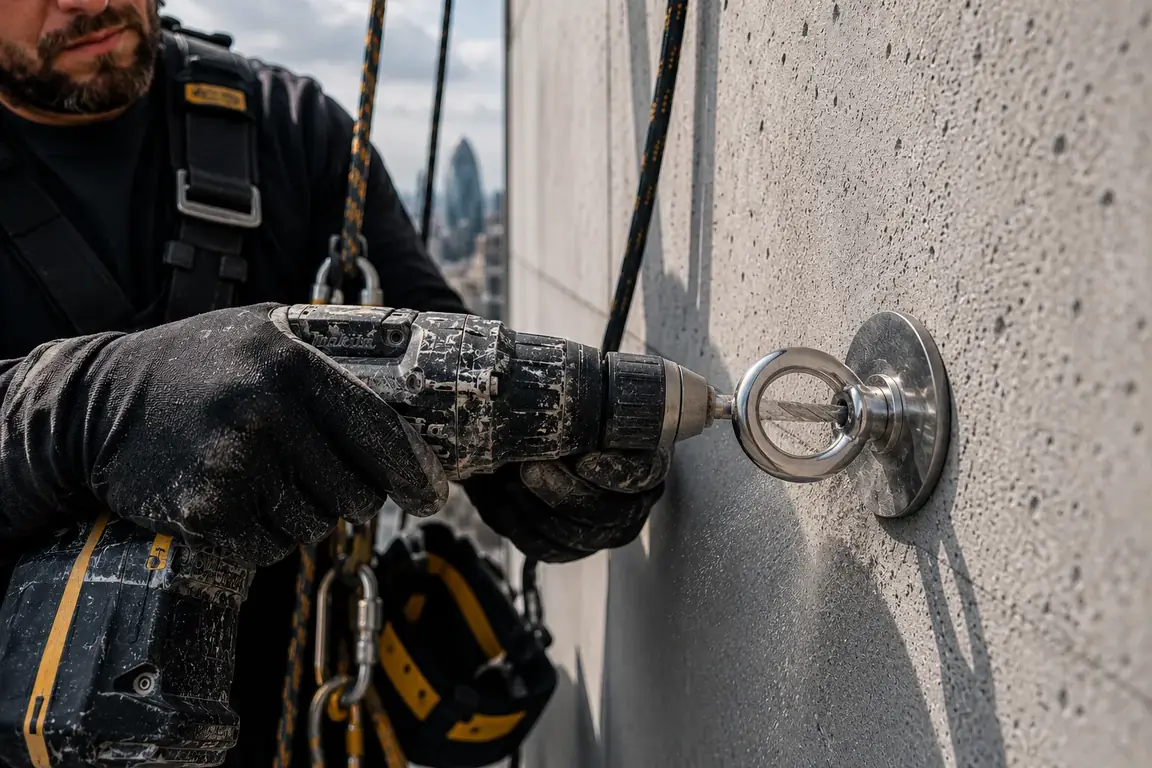
Quick answer: Permanent anchor points are certified fixings, such as roof anchors, eyebolts, horizontal lifelines and rail systems, built into a building so that people working at height can attach fall-protection or rope access equipment safely. They're made to BS EN 795, and designed, installed and inspected under BS 7883, which recommends inspection at least every 12 months by a competent person. For building owners, they mean faster, cheaper and safer maintenance, because without in-date anchors every job starts with workarounds. They only help if they're in date, documented and suitable for the work.
Types of anchor (BS EN 795)
| Type | What it is | Typical use |
|---|---|---|
| Type A | Fixed single-point anchors: roof anchors, wall/soffit eyebolts | Rope access drops, window cleaning, fall arrest |
| Type B | Transportable temporary anchors | Temporary use, not permanent |
| Type C | Horizontal flexible lifelines (cable systems) | Moving along a roof edge or walkway |
| Type D | Rigid horizontal rails | Under-soffit or roof-edge travel |
| Type E | Deadweight anchors on flat roofs | Where the roof can't be penetrated |
Why they matter to property managers
- Every rope access or window cleaning job needs anchorage. In-date anchors mean the team can rig and start quickly.
- No anchors = workarounds: counterweight systems, structural checks or temporary anchors, which add cost and time to every visit.
- Legal duty: the Work at Height Regulations 2005 require work equipment, including anchors, to be suitable and inspected where safety depends on it.
- Liability: using an out-of-date or unsuitable anchor that fails is a serious incident, and the records will be examined.
Inspection and testing
- BS 7883:2019 recommends anchor systems are inspected at least every 12 months, or more often in harsh conditions or with heavy use.
- Inspection is by a competent person and may include visual checks, torque checks and load tests (e.g. pull testing of resin-anchored eyebolts), as appropriate to the anchor type.
- Each anchor should be uniquely identified and recorded.
- Failed or unidentified anchors should be taken out of service and labelled.
What you should hold on file
- Anchor plan / roof plan showing every anchor with ID numbers.
- Installation certificates and design information.
- Latest inspection/test certificate (within 12 months).
- Manufacturer's information and system user instructions.
- Remedial actions from the last inspection: closed or open?
Share these with every contractor before they arrive. It saves time and confirms what's safe to use.
FAQ
How often should anchor points be tested?
BS 7883 recommends inspection at least every 12 months by a competent person, with testing methods appropriate to the anchor type.
Can a rope access team use any anchor on the roof?
No. Only anchors that are suitable for the load and the use, identified and in date. Aerials, pipes, handrails and unknown fixings must never be used.
Our building has no anchors. What now?
Options include deadweight systems, anchoring to proven structure, or installing a permanent system designed to BS 7883. A survey decides which is right.
Check your anchorage
See our rope access in London and services, or request a site survey.
Sources
- BS EN 795:2012, Personal fall protection equipment: anchor devices.
- BS 7883:2019, Personal fall protection equipment: anchor systems: system design, installation and inspection: code of practice.
- Work at Height Regulations 2005, regulation 12 (inspection).


