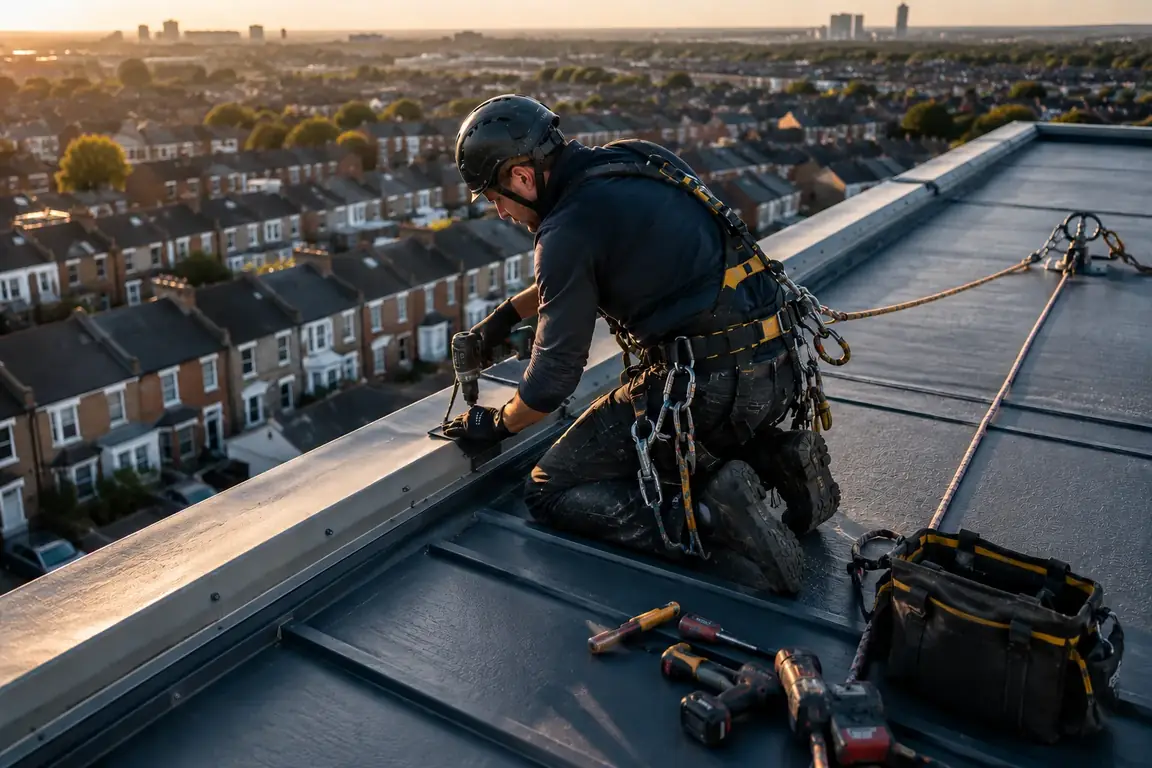
Quick answer: Repairs to steep, high, fragile or enclosed roofs are planned around five things: how to reach the area (rope access, MEWP, scaffold or a combination), what to anchor to, how to protect against fragile surfaces, how to get materials up and waste down, and how to protect people below. For targeted repairs, such as slipped slates, flashings, valleys, chimneys and outlets, rope access often avoids a full scaffold. For re-roofing or heavy work, scaffold is usually still the right answer.
Step 1: Choose the access method
| Repair | Typical best access |
|---|---|
| Re-fixing slipped slates/tiles | Rope access |
| Lead flashing and valley repairs | Rope access (scaffold if extensive) |
| Chimney pots, flaunching, re-pointing | Rope access, or scaffold for rebuilds |
| Gutter, outlet and downpipe repairs | Rope access / MEWP |
| Rooflight replacement | Depends on size and weight; may combine methods |
| Full re-roof / re-covering | Scaffold with edge protection |
The Work at Height Regulations 2005 require the safest practicable method. Collective edge protection, such as scaffold or guardrails, is preferred where it's reasonably practicable. Rope access is justified for short, targeted work where those measures aren't.
Step 2: Anchors
- Existing anchors: must be suitable and in date (BS 7883 recommends inspection at least every 12 months).
- No anchors: options include counterweight systems, anchoring to suitable structure (steel or plant bases, checked first), or installing temporary or permanent anchors.
- Never anchor to aerials, pipework, rooflights, chimney pots or anything not proven to take the load.
Step 3: Fragile surfaces
- Assume rooflights and older sheeting are fragile until confirmed otherwise.
- Use restraint systems that physically prevent technicians reaching fragile areas, or covers/staging rated for the purpose.
- Check the asbestos register before disturbing roof materials.
Step 4: Materials and waste
- Light materials (slates, lead, sealant, mortar) are hauled up by rope or carried in bags.
- Heavier items need a planned lift, such as a hoist or crane, possibly with a lift plan under LOLER.
- Waste goes down in sealed bags, never thrown.
- Lead: handle and dispose of it correctly. Hot work, such as lead welding, needs a hot-works permit.
Step 5: Protect people below
- Exclusion zones below every work area.
- Tethered tools; materials secured on the roof.
- Out-of-hours work over busy entrances where needed.
Weather
Wind, rain and frost affect both safety and quality. Lead work, sealants and mortars all have temperature and moisture limits. Winter repairs are possible, but need flexible programming. Emergency make-safes happen whatever the season.
FAQ
Is rope access roof repair as good as repair from scaffold?
For targeted repairs, yes. The workmanship is the same. Large re-roofing needs scaffold for material handling and a continuous working platform.
Who needs to be involved?
For roofs under warranty, the original roofing manufacturer or installer may need to approve repairs. For structural issues, a structural engineer.
How quickly can urgent repairs be done?
Make-safes can often be arranged quickly, subject to anchors, access and conditions. Call with the details and ask what is possible.
Get a repair plan
See our roof repairs and services, or request a site survey.
Sources
- Work at Height Regulations 2005 (incl. regulation 9, fragile surfaces).
- HSE, Health and safety in roof work (HSG33).
- BS 7883:2019; LOLER 1998; Control of Asbestos Regulations 2012.


