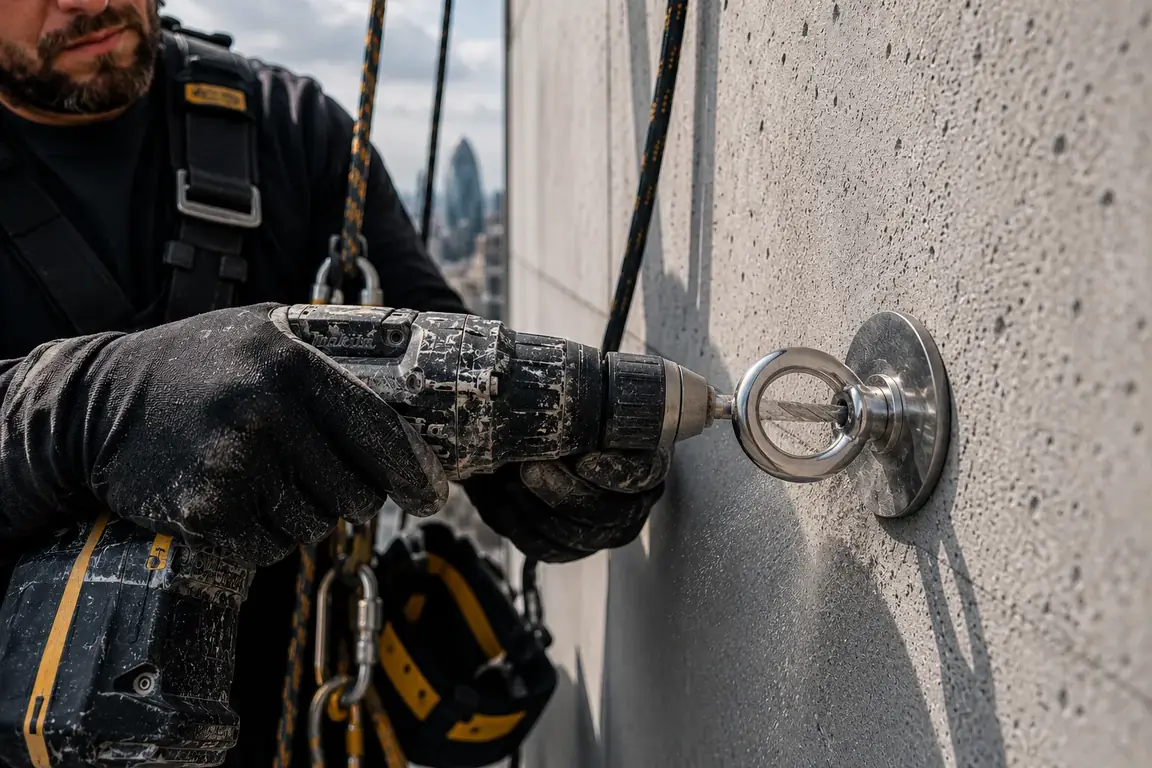
Quick answer: Anchor points on a roof or façade are the connection between a worker's harness and your building. BS 7883, the UK code of practice for anchor devices, recommends inspection at least every 12 months by a competent person, with a written record. Newly installed anchors should be tested at installation, and anchors with no installation or test records should be treated as unproven until they are checked. If your records are out of date, many rope access, window cleaning and maintenance contractors will not attach to them, which delays work and can add cost.
What anchor points are for
Anyone working at height on ropes or in a harness needs something strong to connect to. On buildings that is usually a permanent anchor device: an eyebolt, a bracket, a rail or a post fixed into the structure. Rope access teams, window cleaners and maintenance crews depend on them.
If the anchors are missing, untested or in poor condition, safe access becomes difficult. The work may be delayed, or a more expensive method such as scaffold or a powered platform may be needed instead.
What the rules say
The Work at Height Regulations 2005 require work equipment used for work at height to be suitable and to be inspected where its safety depends on how it was installed, and at suitable intervals afterwards. BS 7883 gives detailed guidance on anchors: design, selection, installation, use and maintenance. A related standard, BS EN 795, covers the anchor devices themselves.
Responsibility for keeping anchors inspected usually sits with whoever owns or controls the building and the equipment. Your health and safety adviser or solicitor can confirm how that applies to your lease and your building.
What an inspection covers
A competent person inspects each anchor and its surroundings. The check typically includes:
- Identification: each anchor is numbered and matched to the location plan and records
- Condition: corrosion, cracks, distortion, wear and damage
- Fixings: looseness, movement, loss of grout or resin, and signs of pull-out
- Surroundings: the roof covering, upstands and sealing around the anchor, since a leaking penetration is a common problem
- Markings and tags: inspection dates, rated loads and identification
- Records: whether the installation details and previous test results exist and match
Where an anchor is in doubt, the inspector may recommend a load test, a repair, or taking it out of use until it has been replaced.
When to inspect sooner than 12 months
| Situation | What to do |
|---|---|
| An anchor has taken a load, such as a fall arrest | Take it out of use and have it inspected before anyone uses it again |
| Roof works or re-roofing near the anchors | Inspect afterwards, and check the weatherproofing around them |
| Visible corrosion, movement or damage | Take it out of use and have it checked |
| No records at all | Treat as untested until a competent person has checked and documented them |
| Change of use, such as new equipment or heavier loads | Review the design and the ratings |
What good records look like
When a contractor asks whether your anchors are certified, the answer should be a single document or file. A good record contains:
- a location plan showing each anchor with its number
- the type, make and rated load of each anchor
- installer details and the installation date
- test results from installation
- the date, name and competence of each inspector, with findings and actions
- any repairs, replacements and removals
Planning new anchors
If your building has no anchors, or the existing ones cannot be relied on, the usual steps are:
- Survey the building. Assess the structure, the roof build-up and how the building will be accessed in future.
- Design the layout. Anchors should be positioned for the drops and tasks that will actually happen, so that technicians are not forced into awkward or unsafe positions.
- Check the structure. A structural engineer may need to confirm that the substrate can carry the loads.
- Install and seal. Penetrations through the roof need proper weatherproofing.
- Test and document. Proof-load each installed anchor and file the records.
Getting this right at the start makes every future cleaning, inspection and repair safer and simpler. Our guide to how to choose a rope access contractor lists what to ask about anchors before work starts.
FAQ
How often should roof anchors be inspected?
BS 7883 recommends at least every 12 months. Inspect sooner after any event that could have damaged them.
What happens if an anchor fails an inspection?
It should be taken out of use and marked as such, then repaired or replaced and retested before it is used again.
Can rope access teams use anchors that have no records?
A responsible contractor will not rely on them until they have been checked. In some cases the contractor can install temporary or alternative arrangements, but that depends on the building.
Do anchors affect the roof warranty?
Penetrations can affect roof warranties if they are not detailed correctly. Involve the roofing contractor or warranty provider when installing or replacing anchors.
Talk to us about your anchors
If you are not sure what anchor provision your building has, or whether it is documented, send us the building address and any records you have. Read about our anchor installation and inspection service, or request a site survey.
Sources
- BS 7883, Code of practice for the design, selection, installation, use and maintenance of anchor devices for harness-based work at height. Check the current edition.
- BS EN 795, Personal fall protection equipment: anchor devices.
- The Work at Height Regulations 2005 (legislation.gov.uk).
- HSE, Work at height guidance (hse.gov.uk).


