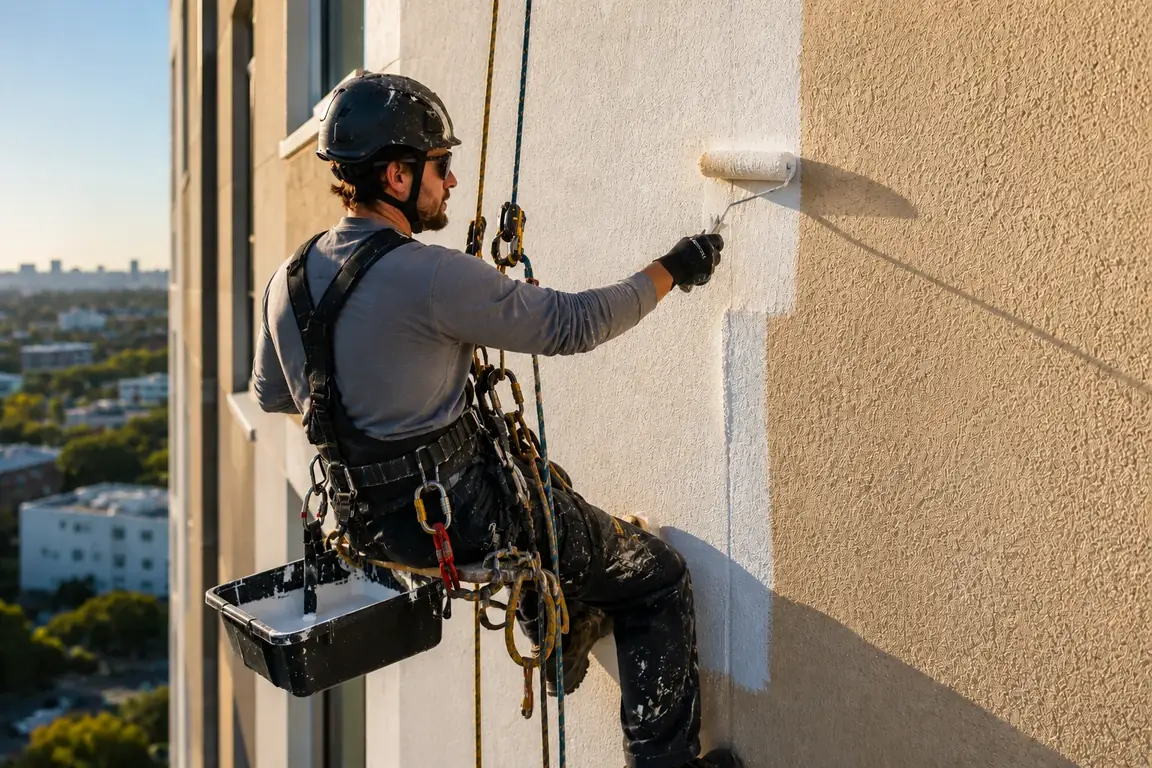
Quick answer: A good external painting specification covers the substrate (render, masonry, timber, metal), the coating system (a compatible primer, undercoat and finish, usually from one manufacturer), surface preparation (the biggest factor in how long the paint lasts), the weather window (dry surfaces, typically above about 5 °C and at least 3 °C above dew point), access (rope access, MEWP or scaffold), lead paint checks on older buildings, and the warranty and handover. Most good external systems last roughly 8–15 years before a full repaint, depending on substrate, exposure and prep.
Access: which method?
| Job | Usual access |
|---|---|
| Stairwells, towers, lift shafts, narrow elevations | Rope access: fast and no scaffold |
| Touch-ups, railings, small areas at height | Rope access / MEWP |
| Full repaint of large, flat elevations | Scaffold often (continuous platform, quality control), sometimes rope access by drops |
| Low-rise with good hardstanding | MEWP |
Rope access painting works best where the coating can be applied drop by drop with good edge control, and where scaffolding would cost more than the painting itself.
What to put in the specification
- Substrate & condition: what's being painted, plus its current state (flaking, chalking, cracking, damp).
- Coating system: manufacturer, primer, undercoat, finish, number of coats and dry film thickness where relevant. Systems should be compatible with what's already there.
- Surface preparation: cleaning, removal of loose and flaking paint, repairs, and treating mould and algae. See why surface preparation matters.
- Application conditions: minimum temperature, maximum humidity, dew point rule, and no application to wet surfaces.
- Colour & finish: with sample areas approved on site.
- Lead paint: on pre-1960s buildings especially, test before disturbing old paint (Control of Lead at Work Regulations 2002).
- Protection: masking of glazing, sealant and adjacent surfaces; overspray control (most rope access painting is brush or roller).
- Inspection hold points: after prep, after primer, and on completion.
- Warranty & records: product data, batch numbers, photos and maintenance guidance.
BS 6150:2019 (Painting of buildings: code of practice) is the key reference for specifiers.
Timing
- Best season: late spring to early autumn.
- Avoid: cold, damp months. Short days and dew make it hard to meet application conditions.
- Plan for weather days: agree how they're handled in the contract.
FAQ
How long does external paint last on a commercial building?
Typically around 8–15 years for good systems on well-prepared surfaces. Exposed, south-facing or poorly prepared areas fail sooner.
Can you paint in winter?
Only on days that meet the product's conditions, which in a UK winter is unreliable. Plan major painting for the warmer months.
Does the paint brand matter?
The system matters more than the brand: compatible products, applied to the manufacturer's specification on properly prepared surfaces. Many manufacturers offer system warranties when their specification is followed.
Get a painting specification
See our external painting and building maintenance, or request a site survey.
Sources
- BS 6150:2019, Painting of buildings: code of practice.
- ISO 8502-4 (dew point assessment before painting).
- Control of Lead at Work Regulations 2002.


