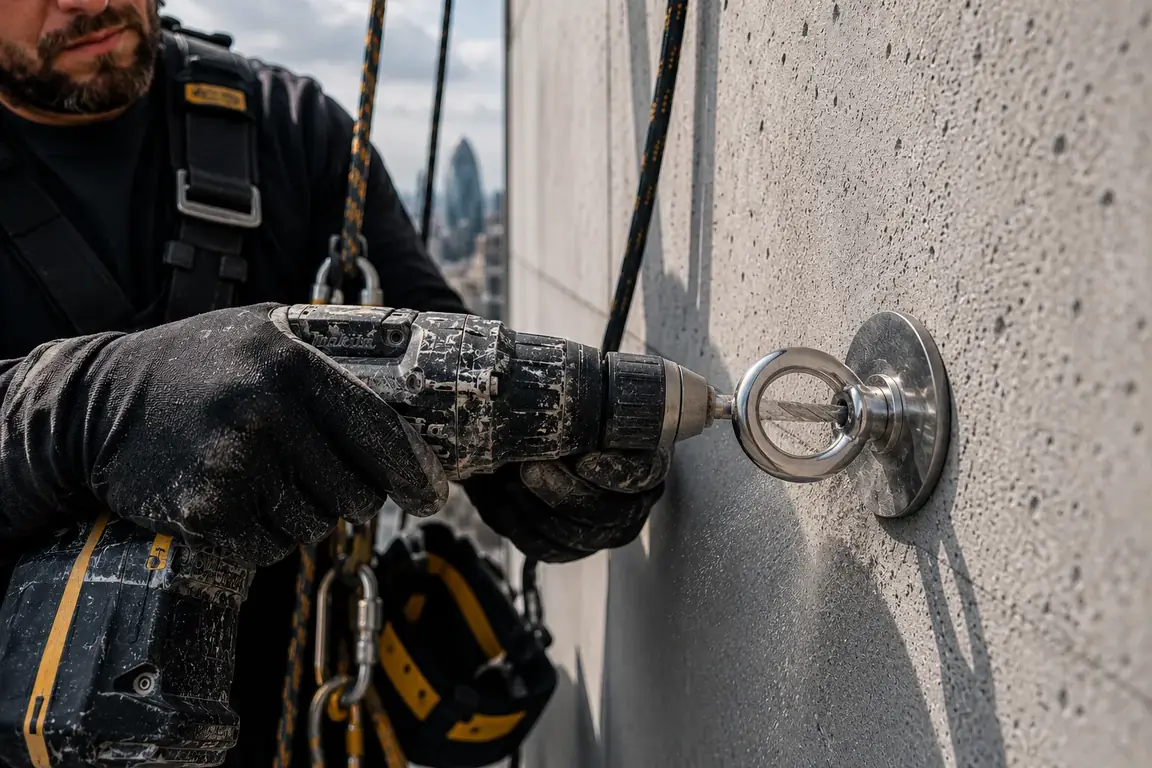
Quick answer: IRATA is the Industrial Rope Access Trade Association, the UK-founded body that sets the main international standard for rope access work. An IRATA certificate shows that a technician has been trained and independently assessed at Level 1, 2 or 3, and it is valid for three years. For a building owner, the key point is this: every IRATA job should be supervised on site by a Level 3, carried out to the IRATA International Code of Practice (ICOP), and run by a team that can rescue its own members. Certification shows the people are competent. It doesn't show that a particular job has been planned properly. You still need to check that.
The three levels in plain English
| Level | What they do on your building | Minimum route to this level |
|---|---|---|
| Level 1 | Carries out rope access work under the supervision of a Level 3. Can perform basic rescues. | Training course followed by an independent IRATA assessment |
| Level 2 | An experienced technician. Rigs working ropes, carries out more complex rescues and can lead tasks under Level 3 supervision. | At least 1,000 logged hours and 12 months as a Level 1, then a course and an independent assessment |
| Level 3 | The supervisor. Responsible for the work site, safety, rigging checks, the rescue plan and the team. Must also hold a current first-aid certificate. | At least 1,000 logged hours and 12 months as a Level 2, then a course and an independent assessment |
Certificates are re-assessed every three years, and every technician keeps a logbook of hours and tasks, signed off by their supervisors. IRATA also expects refresher training after a significant break from rope work.
SPRAT is the North American equivalent. In the UK and London commercial market, IRATA is the scheme you'll see most often.
How rope access stays safe under the ICOP
The ICOP sets out practices that are worth knowing as a client, because you can see them on site:
- Two independent ropes per technician: a working line and a back-up line, each on its own anchor.
- A minimum team of two, so nobody works alone on ropes.
- A Level 3 responsible for the site, named in the method statement.
- A rescue plan that the team can carry out themselves, with the rescue kit rigged and ready.
- Equipment inspection and records before use, and periodically under LOLER.
Individual certificate vs IRATA member company
These are different things, and contractors sometimes blur them.
- Technician certification belongs to the person. Anyone can train and hold it.
- IRATA member company status belongs to the business. Member companies are audited by IRATA on their safety management, training and adherence to the ICOP.
An IRATA member company is a stronger signal, but either way, check the people who will actually turn up.
How to check a certificate in two minutes
- Ask the contractor for the names and IRATA numbers of the proposed team, including the Level 3.
- Use IRATA's online technician verification on irata.org to confirm each certificate's level and expiry date.
- Check the Level 3 is named in the RAMS and will actually be on site.
- If the company says it's a member, look it up in IRATA's member company directory.
What IRATA certification doesn't tell you
A certificate is about the person's rope access skills. On its own it doesn't prove:
- that your building's anchors are in date and suitable (ask for BS 7883 test records);
- that the technician is skilled in the trade task, such as sealant application, glazing, coatings or electrical work. Ask what trade experience the team has;
- that the RAMS properly cover your entrances, tenants and pavement;
- that the firm has the insurance and reporting you need.
That's why IRATA is one item on a full contractor checklist, not the whole checklist. See how to choose a rope access contractor.
FAQ
Is IRATA a legal requirement in the UK?
No law names IRATA specifically. The Work at Height Regulations 2005 require that people working at height are competent and that rope access is planned, supervised and carried out safely. IRATA certification is the most widely recognised way to show that competence, and most commercial clients and insurers expect it.
Can a Level 1 technician work without a Level 3 present?
Not under the IRATA ICOP. All IRATA rope access should be supervised by a Level 3 responsible for the work site.
How long does an IRATA certificate last?
Three years. The technician then needs to be re-assessed to keep their level.
Is IRATA better than SPRAT?
They're comparable schemes. IRATA is far more common in the UK, so it's the easier one to check and compare here.
Work with a fully certified team
Ask us for our team's IRATA numbers and an example RAMS before you commit. Learn about our rope access in London and our full range of services, or request a site survey.
Sources
- IRATA International, International Code of Practice (ICOP), and IRATA training and assessment scheme requirements.
- IRATA technician verification and member directory (irata.org).
- IRATA International, Training requirements (progression needs at least a year's experience and 1,000 logged working hours).
- SpanSet UK, IRATA Level 2 course prerequisites (1,000 hours / 12 months; 3-year validity).
- Work at Height Regulations 2005; LOLER 1998.


