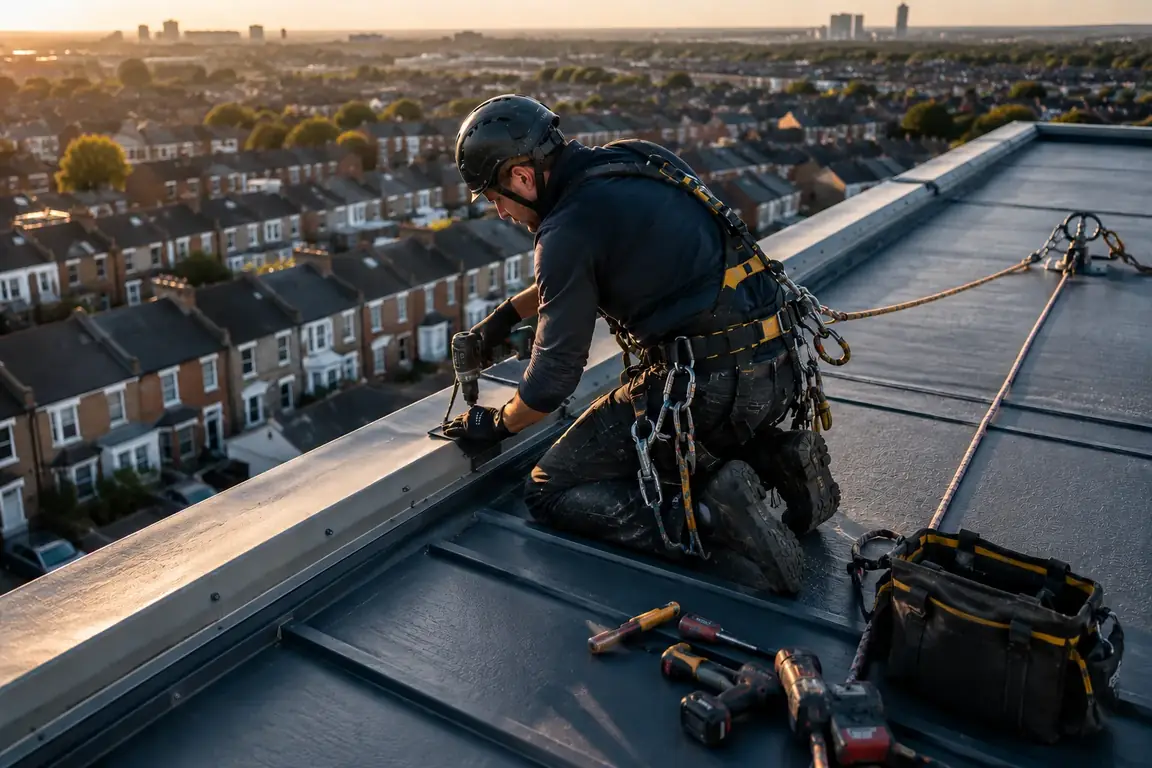
Quick answer: A rope access roof inspection is used where a roof is too steep, too high, too fragile or too awkward for safe walking access or a cherry picker: mansards, pitched slate roofs, domes, glazed roofs, roofs over light wells, and edges over busy streets. Technicians rig from secure anchors, work suspended or restrained so they never rely on the roof surface itself, and inspect coverings, flashings, valleys, gutters, chimneys, parapets and rooflights at arm's length. You get a photo-referenced report with urgency ratings, and small make-safes can usually be done on the same visit.
When rope access is the right way to inspect a roof
| Roof type | Why rope access helps |
|---|---|
| Steep pitched slate/tile, mansards | Safe positioning without scaffolding the whole building |
| Fragile roofs (old asbestos cement sheets, rooflights, glazed roofs) | Work positioning keeps weight off fragile surfaces |
| Domes, spires, turrets | Irregular shapes that scaffold struggles with |
| Roof edges over pavements | Quick access with a controlled exclusion zone below |
| Valleys and gutters behind parapets | Reached without a long scaffold |
| Light wells and internal roofs | No vehicle access possible |
What's inspected
- Coverings: slipped, cracked or missing slates and tiles; split, blistered or failed membranes.
- Flashings & upstands: lifted lead, failed mortar fillets, open laps.
- Valleys & gutters: debris, splits in lead or linings, poor falls, blocked outlets.
- Chimneys & stacks: loose pots, failed flaunching, open joints, leaning.
- Parapets & copings: open joints, failed cappings.
- Rooflights & glazing: cracked panes, failed seals, fragile surfaces.
- Fixings & attachments: aerials, plant supports, lightning protection, bird netting.
Fragile roofs: safety first
HSE identifies falls through fragile surfaces as one of the major causes of death in roof work. Any roof should be treated as fragile until confirmed otherwise, and that includes rooflights and older sheeting. Rope access manages this by:
- anchoring to suitable structure, never to the fragile surface;
- using work-restraint or work-positioning so technicians can't fall through or off;
- planning exclusion zones below roof edges and over internal spaces where relevant.
Where asbestos-containing roof materials may be present, the asbestos register must be checked first (Control of Asbestos Regulations 2012).
What you receive
- Summary of condition and priorities.
- Defect schedule: reference, location, photo, urgency, action.
- Make-safe record, e.g. slipped slates secured or loose pots removed.
- Recommendations: repairs, specialist roofing input, and when to re-inspect.
How often should roofs be inspected?
A widely followed rule of thumb is twice a year (spring and autumn) and after major storms, with gutters cleared at least annually. See how often to inspect a commercial building exterior.
FAQ
Can't a drone inspect the roof?
A drone gives a good overview and can show where to look. It can't lift a slate, check a lead lap, clear an outlet or make anything safe. Use both where that helps.
Will the inspection damage the roof?
No. Ropes are protected at edges, and technicians avoid loading the coverings. Fragile areas are never walked on.
Can repairs be done at the same time?
Small ones, such as re-fixing slates, clearing outlets or minor lead dressing, often can. Larger repairs are scoped from the report.
Book a roof inspection
See our roof repairs and services, or request a site survey.
Sources
- HSE, Health and safety in roof work (HSG33).
- Work at Height Regulations 2005, regulation 9 (fragile surfaces).
- Control of Asbestos Regulations 2012.


