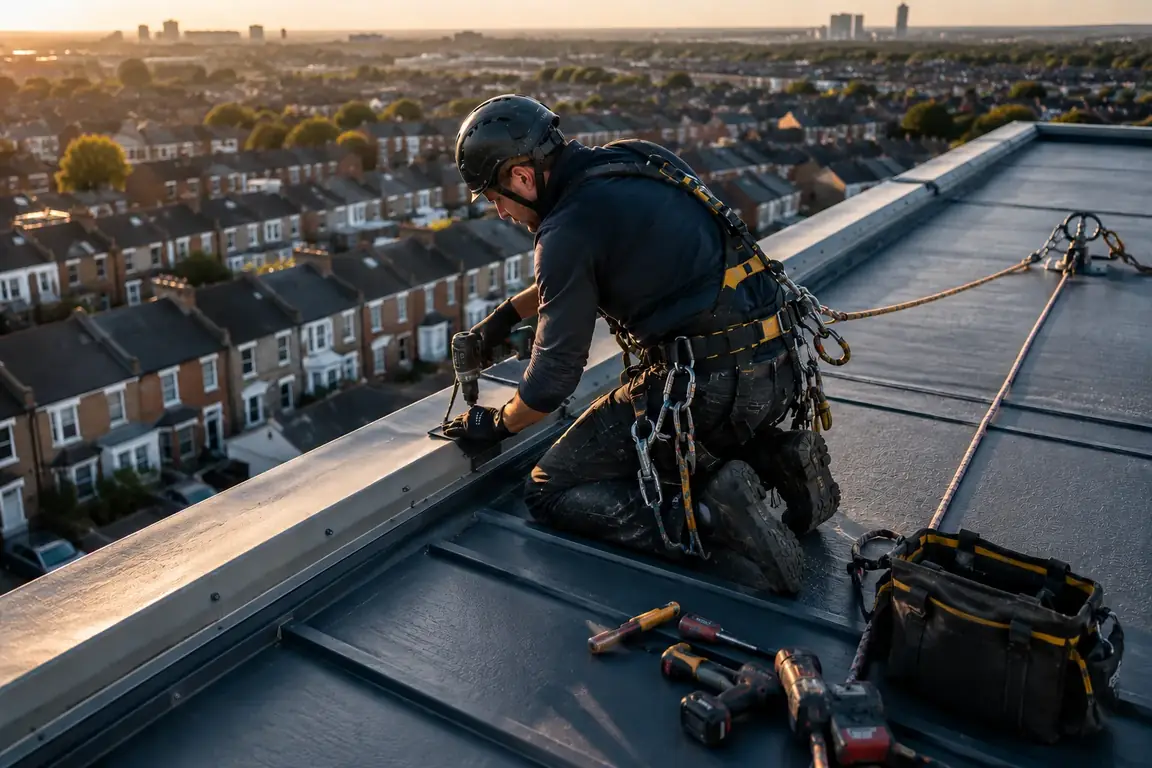
Quick answer: "Façade waterproofing" can mean very different things: re-sealing joints, repairing flashings and copings, applying a water-repellent (e.g. silane/siloxane) to masonry or concrete, or applying a coating. Before approving any of them, make sure the cause of water entry has been confirmed, the product suits the substrate and stays breathable, the work will be tested afterwards, and the warranty is clear. Treating a wall that's leaking through a failed coping won't stop the leak, and the wrong treatment can trap moisture and make things worse.
The 9 questions
1. "Has the cause been confirmed?"
Waterproofing should fix a diagnosed entry route. If it hasn't been diagnosed, start with an investigation. See façade leak investigation.
2. "Which type of waterproofing, and why?"
| Approach | Good for | Not for |
|---|---|---|
| Re-sealing joints | Failed perimeter, movement and panel joints | Water through porous masonry |
| Flashing/coping/cill repairs | Water entering at the top or around openings | Wall-wide porosity |
| Penetrating water-repellent (silane/siloxane) | Porous brick, stone and concrete absorbing driven rain | Cracks, open joints and failed details, which must be repaired first |
| Film-forming coatings | Some concrete and render, as specified | Many masonry walls that need to breathe |
3. "Will the wall still breathe?"
Masonry needs to let moisture out. Non-breathable coatings can trap water, leading to frost damage, salt damage and damp inside. Penetrating repellents are generally designed to keep the substrate vapour-permeable. Check the product data.
4. "Is the product right for this substrate?"
Ask for the data sheet showing suitability for your material, and for concrete, conformity with BS EN 1504-2 where relevant. On historic or listed buildings, many treatments are inappropriate, so take conservation advice and check consent requirements.
5. "What repairs happen first?"
Cracks, open joints, failed pointing and sealant must be repaired before any repellent or coating. Treatments don't bridge defects.
6. "How will it be applied, and in what conditions?"
Most products need dry substrates and minimum temperatures. Ask about the weather window and coverage rates.
7. "How will we know it worked?"
Agree testing: a water spray test on repaired areas, or the inspection of a trial area. For curtain walling, site testing to BS EN 13051 may be appropriate.
8. "What's the warranty, and who backs it?"
Distinguish product warranties (from the manufacturer) from workmanship warranties (from the contractor), and check any conditions such as maintenance or inspection.
9. "What maintenance does it need?"
Repellents wear over time, often needing reapplication after a number of years depending on product and exposure. Sealant has a finite life.
FAQ
Do water-repellent treatments stop leaks?
They reduce rain absorption through porous masonry. They don't fix cracks, open joints or failed details, which are the cause of most leaks.
Can waterproofing be done by rope access?
Yes. Re-sealing, flashing repairs and repellent application are all well suited to rope access.
How long does façade waterproofing last?
It depends on the type: sealant roughly 10–20 years, repellents typically several years to over a decade depending on the product, and repairs to details for much longer if done well.
Get the right fix
See our waterproofing and building maintenance, or request a site survey.
Sources
- BS EN 1504-2 (surface protection systems for concrete).
- BS 6213 (selection of construction sealants).
- BS EN 13051 (curtain walling site water test).
- Historic England guidance on water repellents for historic masonry.


