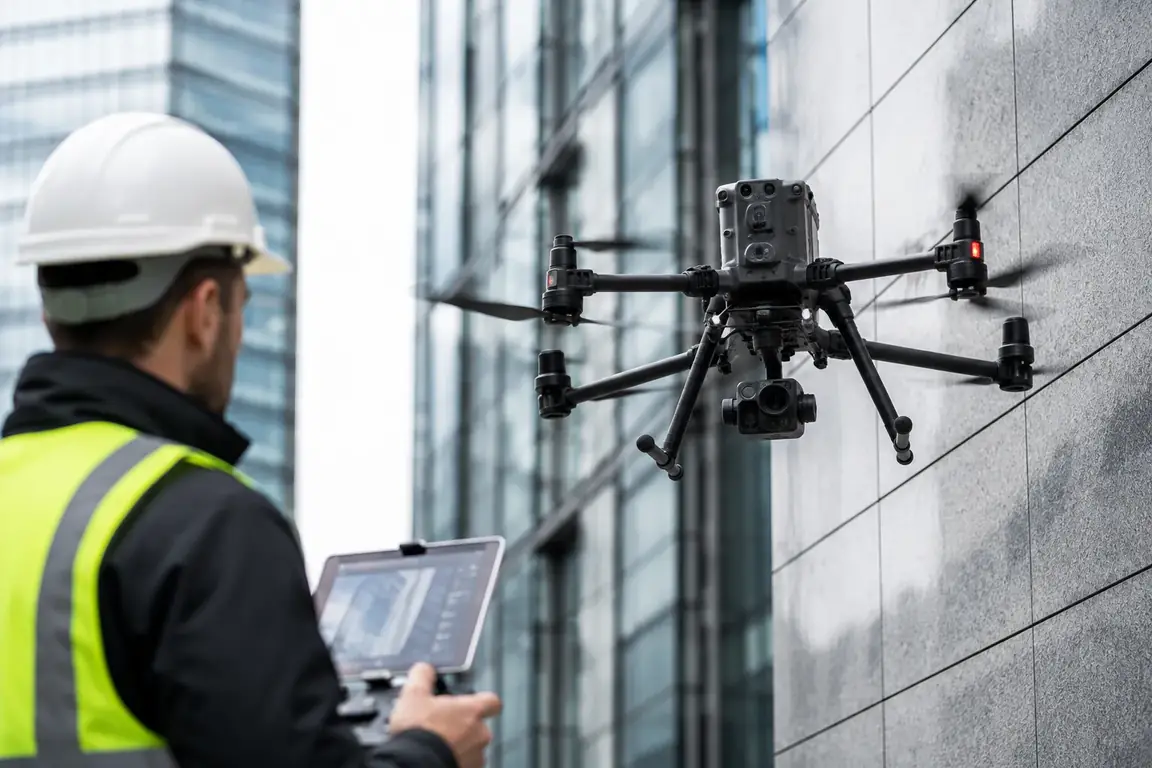
Quick answer: A drone gives you a fast, low-disruption first look at a façade or roof: close-up photographs and video of areas that are hard to reach, taken without ropes, scaffold or anyone working at height. It is very good for spotting visible defects, checking a roof after a storm and planning work. It cannot touch, tap, measure or test anything, and it cannot see what is hidden behind cladding or inside the building. Use a drone to find out where to look, then follow up with a hands-on rope access inspection wherever the images show something that needs checking.
What a drone inspection is good for
| Good for | Why |
|---|---|
| Roof condition checks | Covers a whole roof in one visit without anyone walking on it |
| Storm and incident checks | Quick, safe look at damage before deciding what to do |
| Screening a whole elevation | Shows patterns of staining, cracking or missing elements across a large area |
| Planning maintenance | Helps scope work and budget before committing to access |
| Records | Dated, location-tagged images give you a baseline to compare against next year |
| Hard-to-reach areas | Parapets, copings, plant areas, lightwells and the tops of tall buildings |
What it cannot do
| Not good for | What to use instead |
|---|---|
| Tap testing render, stone or tiles for hollow areas | Hands-on rope access inspection |
| Measuring crack width or movement accurately | Close inspection with a crack gauge, and monitoring over time |
| Checking sealant adhesion | Hands-on testing |
| Checking fixings and brackets | Hands-on inspection |
| Seeing behind cladding or inside walls | Opening-up works or specialist surveys |
| Structural assessment | A structural engineer |
| Repairs of any kind | Rope access, scaffold or another access method |
A drone shows the surface. Cracks, staining and loose elements are often visible, but the cause usually needs a closer look. Our guide to ten signs your façade needs an inspection explains what to look for in the images.
What you should receive
A useful drone inspection delivers more than a folder of photographs. Ask for:
- High-resolution images and video, labelled by elevation, level or grid reference
- Location-tagged findings, so someone can find each defect again
- A defect log with a short description and a priority rating for each item
- Recommendations, including which items need a hands-on check or repair
- The date and conditions of the flight, so you can compare later inspections
Limits to expect
- Weather. Wind, rain and poor light reduce what is safe and what is visible.
- Glass and reflections. Glare can hide defects on glazed façades.
- Recesses and undersides. Soffits, deep reveals and areas behind projections may be impossible to see clearly.
- Surroundings. Busy streets, nearby people and neighbouring buildings limit where and how a drone can fly, particularly in central London.
- Airspace restrictions. Some locations need extra permissions before any flight.
The rules operators follow
In the UK, drone flights are regulated by the Civil Aviation Authority (CAA). Commercial operators should be registered, hold the qualifications and permissions that apply to the type of flight, and carry insurance. Operating near people, roads and buildings brings extra requirements.
Before you instruct anyone, it is reasonable to ask to see:
- their CAA registration and permissions
- their insurance for commercial drone work
- a flight plan and risk assessment for your site
- how they will protect people and traffic nearby
There is also a privacy question. A drone can capture neighbouring windows and people. Ask how the images will be stored, who can see them, and how any unrelated personal data will be handled. The Information Commissioner's Office publishes guidance on using drones.
When to follow up with rope access
A drone survey and a rope access inspection work best together. A typical sequence looks like this:
- Drone survey of the whole building, to find and record visible defects.
- Review the findings and sort them into urgent, planned and monitor.
- Rope access follow-up on the items that need touching, testing, measuring or repairing.
- Repairs, carried out by the same team where possible.
This avoids paying for hands-on access across the whole building when only a few areas need it. It is the same reasoning we explain in rope access vs scaffolding: choose the access method that suits each task.
A checklist for commissioning a drone inspection
- What do you need to know: general condition, a storm check, or a specific problem?
- Which elevations, roofs and details are in scope?
- Who owns the building and who must give permission to fly?
- Are there restrictions nearby, such as roads, public spaces or sensitive sites?
- What will the report contain, and in what format?
- Who keeps the images, and for how long?
- What is the weather plan if the flight is postponed?
FAQ
Is a drone inspection cheaper than a rope access inspection?
For a first look at a large or hard-to-reach area, it is often quicker, because there is no rigging. Cost depends on the size of the building, the access and the report you need. We quote after discussing the scope.
Can a drone replace a structural survey?
No. A drone provides visual evidence of the surface condition. Structural concerns need a structural engineer.
Can drones inspect a roof without anyone going up?
For visible condition, yes. Repairs, and anything that needs touching or testing, still need a person on the roof or on ropes.
Can a drone clean as well as inspect?
Tethered drones can wash large glass, cladding and roof areas. That is a separate service with its own limits. See our drone cleaning page.
Talk to us about your building
Tell us the address and what you want to learn, and we will say whether a drone survey, a rope access inspection or both makes sense. Read about our drone building inspection service, or request a site survey.
Sources
- UK Civil Aviation Authority, Unmanned Aircraft System Operations in UK Airspace: Guidance and Policy (CAP 722), and the CAA's current drone rules.
- Information Commissioner's Office, guidance on the use of drones and data protection.


