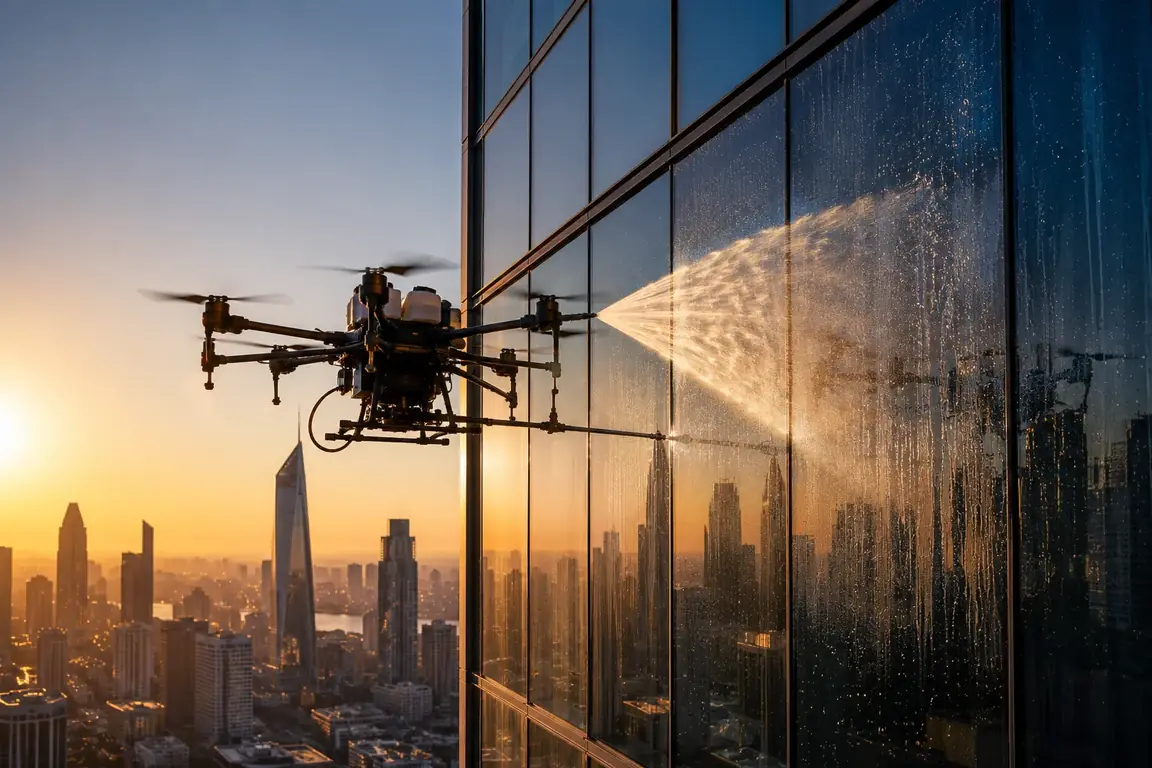
Quick answer: A tethered drone carries a spray head and is fed water and cleaning solution through a hose from a ground unit. It washes and rinses large, fairly uniform surfaces such as glass, cladding and roofs quickly, with no one working at height during the washing stage. It does not scrub, so it suits light to moderate soiling, and it cannot reach into deep recesses, detailed areas or heavily stained surfaces. It also depends on calm, dry weather, a safe take-off area, a water supply and a controlled area below. For many buildings the best result is drone washing for the large areas and rope access for detail and heavier cleaning.
How it works
The drone stays connected to a tether and hose. The operator flies it along the surface and sprays cleaning solution, then rinses. Because the water and solution come from the ground, the drone itself carries little weight, and the whole system works within a defined area. It is a spray-and-rinse method: the water and the product do the work, not brushing.
What it does well
| Advantage | Why it matters |
|---|---|
| No one working at height during the drone stage | Removes the risk of a technician falling during that stage, and the need for anchors on that elevation. Any rope access follow-up is planned separately |
| Speed on large areas | Can cover big glazed or clad surfaces quickly |
| Minimal street footprint | No scaffold, cradle or platform to set up, though a cordon is still needed |
| Hard-to-reach surfaces | Can reach roofs, canopies and large sheds where access is awkward |
| Lower disruption | Can be completed with little interference to the building |
What it cannot do
| Limit | Why |
|---|---|
| Scrub or hand-agitate | There is no brushing, so heavy or bonded dirt may remain |
| Reach deep recesses and fine detail | Spray direction and drone position are limited |
| Clean frames, edges and complex shapes to a high standard | Needs hand cleaning |
| Work in strong wind or rain | Flights stop when conditions are unsafe |
| Remove staining, paint or hard mineral deposits | Needs specialist treatment |
| Work without a water supply and ground space | The system depends on the tether and hose |
Some surfaces also suit hand cleaning better: delicate stone, heritage fabric and finishes that need a specific method. See cleaning different façade materials.
When it fits
- Large, simple glazed or clad elevations with light to moderate soiling
- Big roofs and canopies where walking or access is hard
- Between full cleans, to keep a building presentable at lower cost and disruption
- Where access is difficult, such as tall, sheer or obstructed frontages
- Where reducing work at height is a priority and the surface suits spray cleaning
When rope access is the better choice
- Detailed façades with frames, fins, recesses and complex features
- Heavy soiling or staining that needs brushing or treatment
- Delicate or specialist surfaces, where method and control matter
- Cleaning together with inspection or repair, because a technician can see and fix as they go
- Locations where a drone cannot fly safely, such as restricted airspace or very crowded streets
Our guide to façade cleaning methods compared puts drone washing alongside the other methods.
Safety and rules
Drone flights in the UK are regulated by the Civil Aviation Authority (CAA). Commercial operators should be registered, hold the right permissions and qualifications, and carry insurance. For washing:
- the area below is cordoned off so no one is underneath
- flights follow a plan and risk assessment for your site
- wind and weather limits are set, and work stops if they are exceeded
- water, chemicals and run-off are managed
- neighbours' windows and privacy are considered
See what drone inspections can and can't show for questions to ask any drone operator, and public safety during façade work for how the area below is protected.
Questions to ask
- Which surfaces will be washed, and are they suitable for spray cleaning?
- What result should I expect, and where will hand cleaning still be needed?
- What are the weather limits and the plan if the day is lost?
- How will the area below be controlled?
- What CAA registration, permissions and insurance does the operator hold?
- What products will be used and how is run-off managed?
- What do you need from us: water supply, ground space and permissions?
FAQ
Is a drone clean as good as hand cleaning?
On suitable surfaces with light to moderate soiling, it can give a good, even result. For detail and heavy soiling, hand cleaning is better.
Is it cheaper than rope access?
For large, simple areas it is often quicker, which can reduce cost. The answer depends on the building, the soiling and the access, so ask for a quote for each method.
Can drones clean windows?
They can wash and rinse large areas of glass. Frames, edges and detail usually need follow-up by hand.
Can the same company do both?
Yes, and it helps. A combined approach lets each method do what it does best, with one plan and one point of contact.
Talk to us
Tell us about your building and what you want cleaned. We will say whether drone washing, rope access or a mix suits it. Read about our drone cleaning and façade cleaning services, or request a site survey.
Sources
- UK Civil Aviation Authority, Unmanned Aircraft System Operations in UK Airspace: Guidance and Policy (CAP 722), and the CAA's current drone rules.
- Manufacturer guidance for cleaning products and for the surfaces being cleaned.
- The Work at Height Regulations 2005 (legislation.gov.uk).


