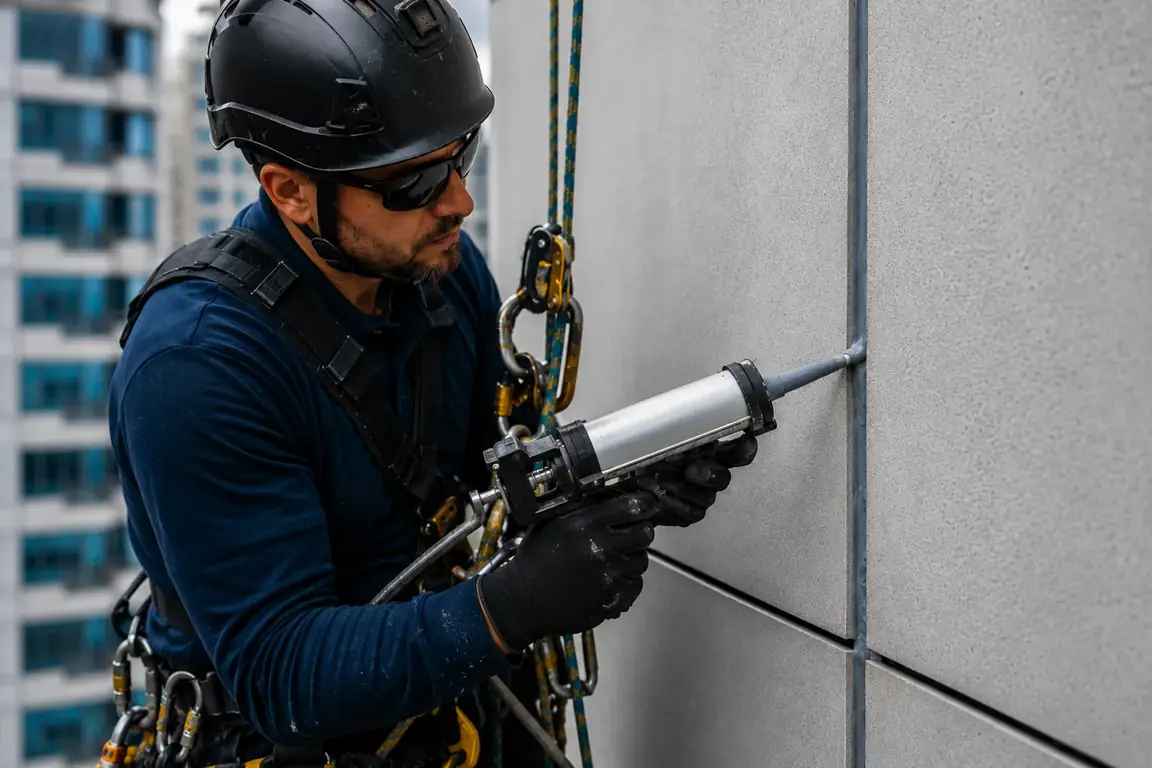
Quick answer: Façade sealant is a consumable. Depending on the product and how exposed the building is, it often lasts around 10 to 20 years, and less on south and west elevations or at the top of tall buildings. Replace it when you see splits, peeling edges, hard or crumbling material, gaps, or water staining below a joint. Replace the whole joint, not a patch: cut out the old sealant, clean and prepare the joint, fit the correct backing, then re-seal with a product suited to the surfaces and the movement. Work in dry, mild conditions, generally above 5 °C, and always follow the manufacturer's data sheet.
What façade sealant actually does
Buildings move. They expand in sun, contract in cold, sway in wind and settle over time. Joints between panels, around windows and under copings are designed to take that movement, and sealant keeps the weather out while the joint flexes.
When the sealant fails, the joint still moves, but nothing stops water getting past it. The water then travels into the wall, insulation or the interior, often a long way from where it entered. That is why failed sealant is a common starting point for leaks, damp and corroded fixings.
Signs your sealant has failed
| What you see | What it usually means | How urgent |
|---|---|---|
| Sealant peeling away from one edge of the joint | Adhesive failure. The bond to the surface has gone, so there is a gap for water | High: plan replacement soon |
| Sealant split down the middle | Cohesive failure. The joint moved more than the sealant could take, or it has aged | High |
| Hard, brittle, cracked or crumbling surface | Ageing and UV exposure. It has lost its flexibility | Medium: replace before it splits |
| Gaps, shrinkage or a sunken look | Sealant has shrunk or was applied too thinly | Medium to high |
| Missing sealant | Joint is open to the weather | Urgent |
| Dark streaks or staining below a joint | Water or dirt tracking out of the joint | Investigate |
| Blisters or bubbles | Trapped moisture or air, or a cure problem | Medium |
| Black mould along the joint | Moisture sitting in or behind the joint | Medium |
A quick test from ground level is hard, because most failures are small and high up. Photographs taken with a zoom lens, or a close inspection from rope access or a drone, will show far more than the eye. Our guide to ten signs your façade needs an inspection covers the wider picture.
Why sealant fails
- Age and UV. Sealants gradually harden and lose elasticity.
- Movement beyond capacity. Every product has a stated movement capability, often shown as a percentage of the joint width. If the joint moves more than that, the sealant tears.
- Poor joint design. Joints that are too narrow, too deep or not fitted with a backing rod can pull the sealant apart. Sealant should bond on two sides only, not three.
- Poor preparation. Dust, damp, old sealant residue or missing primer stop the new sealant bonding properly. This is the most common cause of early failure.
- The wrong product. Some sealants stain porous stone, some will not stick to certain coatings or gaskets, and some cannot be painted over.
- Over-painting. Paint on a flexible sealant can crack and flake as the joint moves.
Why patching rarely works
It is tempting to run a bead of new sealant over a split one. It usually fails within a season, because the new sealant bonds to the old one, which has already lost its grip. The correct repair is to remove the old sealant fully and re-seal from a clean, prepared joint. If you are being quoted for "mastic over the top", ask why.
How a proper sealant replacement is done
- Survey the joints. Record locations, types, widths and condition, with photographs.
- Identify the substrates and the old sealant. This decides the primer, the new product and the cleaning method.
- Cut out the old sealant along both edges and remove it completely.
- Clean and prepare the surfaces so they are dry, sound and free of dust and residues. Use primer where the data sheet requires it.
- Check the joint size and fit backing rod or a bond-breaker, so the new sealant has the right depth and is not stuck to the back of the joint.
- Apply the sealant and tool it for good contact with both sides. Mask the surfaces to keep the finish clean.
- Protect it while it cures, and keep a record of products, batches and locations.
Where practical, an adhesion test on a sample joint before and after the work shows whether the preparation is working.
Timing and weather
Most sealants need dry surfaces and temperatures within the range on their data sheet, typically from about 5 °C upwards. Rain, frost, condensation and very hot surfaces all cause problems. In London, the practical working window is usually spring to early autumn, although short mild, dry spells at other times can work. If sealing has to wait, make sure open joints are protected in the meantime. Our winter exterior maintenance checklist explains what to check before cold weather arrives.
A note on older buildings
Some joint sealants used in buildings from around the 1950s to the 1970s have been found to contain hazardous substances, including PCBs. If your building is of that era and you plan to cut out old sealant, ask your contractor how they will identify and handle the material before work starts.
Why rope access suits sealant work
Joints run in long vertical and horizontal lines. A rope access technician can work down a joint line in a single descent, reach every elevation without scaffold, and leave the street and entrances clear. For a long programme that also needs materials stored at height, or heavy repair work on one elevation, scaffold can be the better choice. See our guide to rope access vs scaffolding.
FAQ
How long does façade sealant last?
It depends on the product, the joint and the exposure. Many last around 10 to 20 years, and some fail much sooner on harsh elevations. Check the manufacturer's guidance and inspect joints regularly.
Does failed sealant always mean there is a leak?
No. A joint can be open and the wall behind it can still be dry, because many façades have a second line of defence. But a failed seal is a weak point, and it is cheaper to fix before water gets in. If you already have a leak, see our guide to façade leak investigation.
Can I just re-seal the windows that are leaking?
Only if the window joint is the source. Water often enters elsewhere and shows up at the window. Find the source first.
What is the difference between sealant work and waterproofing?
Sealant renews the flexible joints between components. Waterproofing treats surfaces, cracks and coatings. Many buildings need both.
Get your joints checked
Send us photographs of the joints you are worried about and the building address. We will tell you honestly what we can see and whether replacement is needed. Read about our sealant works and waterproofing, or request a site survey.
Sources
- Manufacturer technical data sheets for the sealant and primer in use (movement capability, temperature limits, substrates).
- BS 6213, Selection of construction sealants: guide.
- BS EN ISO 11600, Building construction: jointing products: classification and requirements for sealants.


