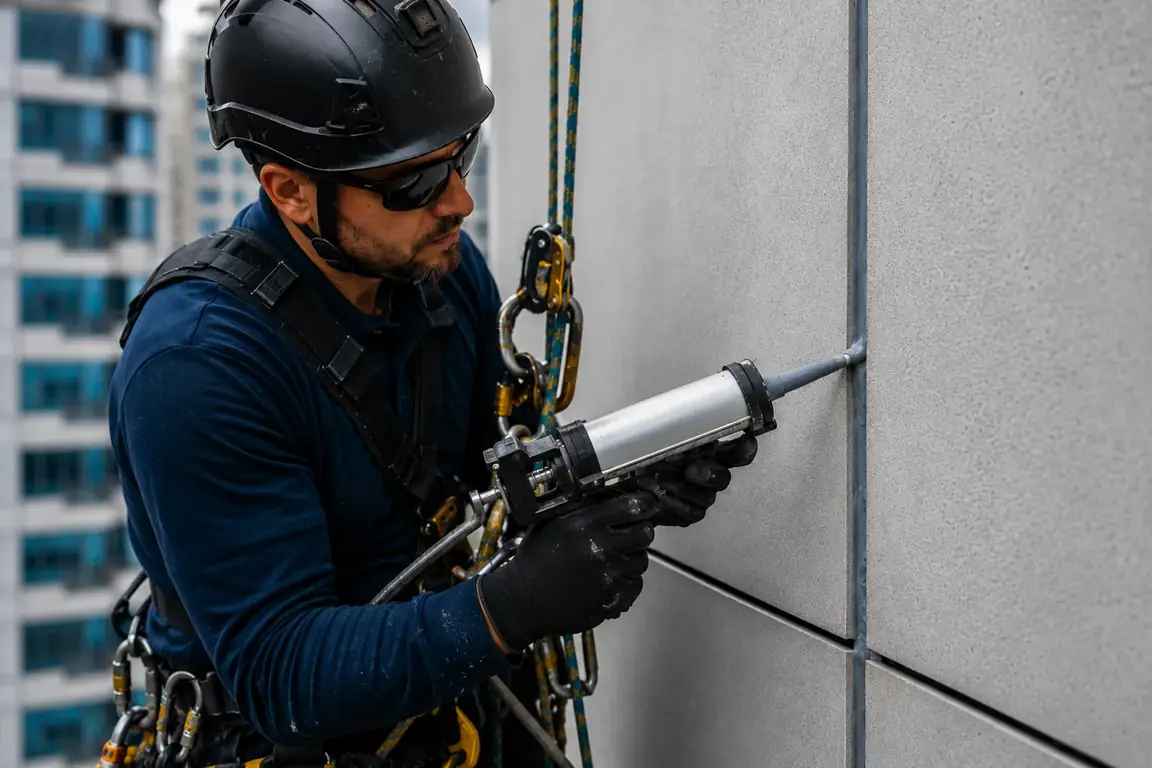
Quick answer: There is no single "best" façade sealant. The right one depends on the surfaces it bonds to, how much the joint moves, how exposed it is, and whether it needs painting. In broad terms, silicones are flexible and durable but cannot be painted and can stain some porous stone, polyurethanes are tough and paintable but less resistant to UV, hybrid (MS polymer) sealants combine good adhesion with paintability, acrylics suit low-movement joints, and polysulphides are a specialist, older option. The product data sheet, the substrate and the joint design should decide it, not habit or price alone.
What the sealant has to do
A façade sealant must:
- bond to both sides of the joint without peeling away
- stretch and compress as the joint moves, without tearing
- resist sun, rain, frost, pollution and cleaning
- last for a reasonable period
- look right, and not stain or attract dirt
- suit what happens next, for example if it will be painted or sit beside a gasket
No sealant does all of these perfectly in every situation. That is why choosing the right one matters.
The main types
| Type | Movement capability | UV and weather resistance | Paintable? | Notes |
|---|---|---|---|---|
| Silicone | Often high | Excellent | Generally no | Very durable and flexible. Can stain some porous stone unless a low-staining product is used. Popular for glazing and many joints |
| Polyurethane (PU) | Medium to high | Moderate. Often painted for protection | Yes | Tough and durable, widely used in construction joints. Can degrade in strong UV if left unprotected |
| MS polymer / hybrid | Medium to high | Good | Yes | Good adhesion on many surfaces, often with little or no primer. A versatile all-rounder |
| Acrylic | Low | Moderate | Yes | Easy to use, water-based. Suited to low-movement joints and fine gaps, not high-movement façade joints |
| Polysulphide | Medium | Good chemical resistance | Often | An older, specialist type found in some existing joints. Can harden with age |
This table is a guide. Actual performance varies by product, and the manufacturer's data sheet is the authority.
Classifying sealants
Sealants for buildings are classified under BS EN ISO 11600. It divides them by use, such as facade (F) and glazing (G), and by movement capability, expressed as a percentage of the joint width, for example 12.5, 20, 25 or 35. A higher number means the joint can move more without the sealant failing. The data sheet states which classes a product meets.
Matching the sealant to the job
| Situation | Things to consider |
|---|---|
| Joints between panels and cladding | Movement, compatibility with the panel finish and any painting needed |
| Window and door perimeters | Compatibility with frames, glazing and gaskets, and movement |
| Natural stone joints | Risk of staining, and compatibility. Use a product designed for stone where required |
| Concrete and precast joints | Movement and bond to the concrete |
| Glazing and curtain wall | Compatibility with gaskets, glazing materials and the system manufacturer's requirements. See curtain wall maintenance |
| Joints that will be painted | Choose a sealant that accepts paint, and check compatibility |
| Heritage and historic buildings | Specialist advice, because inappropriate products can damage fabric. See listed buildings and conservation areas |
Compatibility matters
Many failures come from mixing materials that do not get on:
- Silicone over old sealant or on top of other products often fails to bond. Remove the old sealant fully.
- Some sealants attack gaskets, or are attacked by them, and can cause staining or softening.
- Primers may be required for certain surfaces, and the wrong or missing primer causes adhesion failure.
- Paint over some sealants cracks or will not stick.
- Residues from previous products and cleaning chemicals can prevent bonding.
When replacing sealant, the contractor should identify what is there, test adhesion and choose a compatible product. See façade sealant failure: signs and replacement.
Joint design is as important as the product
Even the best sealant fails in a poorly designed joint:
- The width and depth must suit the sealant and its movement capability. A common rule is that depth should be about half the width, but follow the data sheet.
- A backing rod or bond-breaker keeps the sealant from sticking to the back of the joint, so it can stretch properly. The sealant should bond on two sides only.
- The surfaces must be clean, dry and sound.
- The joint must be large enough for the expected movement.
Staining and appearance
Some sealants can stain porous stone and render, because components can migrate into the material, leaving dark edges. Others attract dirt, or change colour. If appearance matters, ask for a product proven on your material, and test it first.
Weather and application
Sealants need suitable conditions: dry surfaces and temperatures within the product's range, generally above about 5 °C. See façade sealant failure for more on timing, and façade waterproofing coatings for when coatings and sealants work together.
Questions to ask a contractor
- Which sealant is proposed for each joint, and why?
- Does it suit the surfaces and the expected movement?
- Is a primer needed?
- Is it compatible with the existing materials and any gaskets?
- Will the joint need painting?
- Is there a risk of staining?
- What does the data sheet say about its life and conditions?
- What warranty is offered?
FAQ
Which sealant lasts longest?
It depends on the type, the joint and the exposure. Many silicones and hybrids last many years when applied correctly in a suitable joint. Preparation matters more than the brand.
Can I use bathroom silicone outside?
No. Construction sealants are made to cope with movement and weather. Choose a product designed for the job.
Can sealant be painted?
Some types can and some cannot. Check the data sheet and choose accordingly.
Can I put new sealant over old?
Usually not. Remove the old sealant and re-seal.
Talk to us
If you have failed or ageing joints, send us photographs and the building address. We can look at the joints and tell you what we see. Read about our sealant works, or request a site survey.
Sources
- BS EN ISO 11600, Building construction: jointing products: classification and requirements for sealants. Check the current edition.
- BS 6213, Selection of construction sealants: guide.
- Manufacturer technical data sheets for the sealant, primer and substrate.


