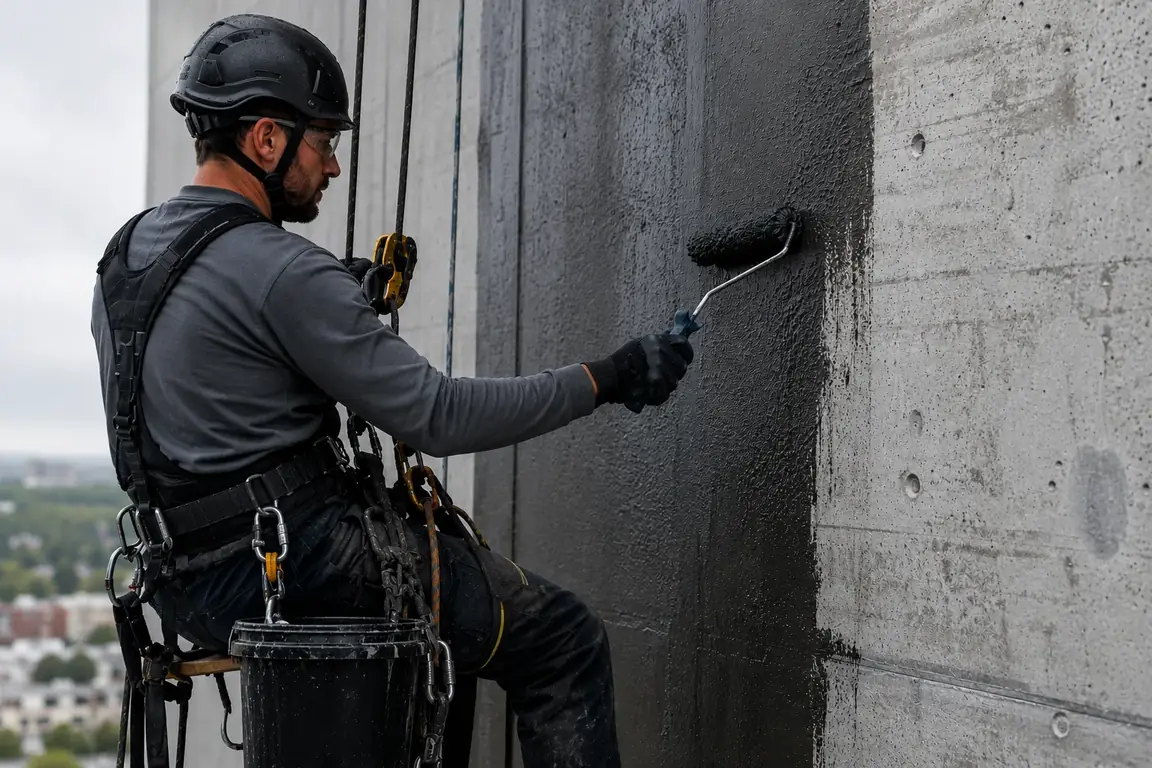
Quick answer: A waterproofing coating or water-repellent treatment can protect a façade from rain, but only if the wall underneath is sound and the source of the water has been found. Coatings reduce water soaking into the surface. They do not fix open cracks, failed joints, leaking copings or defective flashings, and a coating applied over a wall that is already damp can trap moisture and make things worse. The right order is: investigate, repair, then coat. Choose a product that suits the surface, allows the wall to breathe where it needs to, and ask what the manufacturer's warranty actually covers.
Two different things people call "waterproofing"
| Type | What it does | Typical use | Watch out for |
|---|---|---|---|
| Water-repellent treatment (often silane or siloxane based, clear) | Soaks into the surface and makes it shed water, while staying vapour-permeable | Brick, stone and some renders where the appearance must not change | Does not bridge cracks, and works only on surfaces that can absorb it |
| Film-forming coating (paint-like) | Forms a continuous layer on the surface that resists water | Render, concrete and some masonry | Can trap moisture if the wall is damp or the coating is not vapour-permeable, and will peel if applied over unsound surfaces |
Neither is a cure for a leak. Both are a protective layer on a surface that is already in good repair.
When a coating is a good idea
- The wall is absorbing a lot of rain and staying damp, but the structure is sound.
- You have repaired cracks and failed joints and want to reduce future water uptake.
- A porous brick or stone façade is suffering from damp patches, algae or frost damage.
- Render or concrete is weathering and needs a protective coating anyway as part of a repaint.
- You are keeping the original look of a historic or sensitive building and need a clear treatment, subject to the right approvals.
When a coating is the wrong answer
| Situation | Why a coating will not help | What to do instead |
|---|---|---|
| Water is entering through a failed joint or open crack | The coating cannot span movement joints or wide cracks | Re-seal or repair the joint first. See our guide to façade sealant failure |
| Water enters at a coping, parapet, flashing or window head | The defect is in the detail, not the wall surface | Repair the detail |
| The wall is already saturated or has rising or internal damp | A coating can trap the moisture behind it | Find and fix the moisture source, and let the wall dry |
| Salts are coming out of the masonry (white crust) | Salts can push a coating off | Deal with the moisture source and clean before coating |
| The substrate is loose, hollow or flaking | The coating will not bond | Repair or replace the unsound areas |
| The leak has not been traced | You may be coating the wrong wall | Investigate first. See façade leak investigation |
Breathability matters
Most older walls, and many modern ones, need to let moisture vapour out. A coating that seals the surface completely can hold water in the wall, leading to blistering, freeze–thaw damage and decay behind the coating. Ask for the product's vapour permeability and make sure it suits the substrate. This matters even more on solid brick, stone and traditional buildings.
How a sound waterproofing job is done
- Investigate. Find where water is entering and how the wall behaves in rain. Use a leak diary and, where needed, water testing.
- Survey the surface. Check the substrate, moisture levels, existing coatings, cracks, spalling and salts.
- Repair first. Fix cracks, re-seal joints, repair copings and flashings, and replace damaged units.
- Clean and prepare. Remove biological growth, dirt and loose material. Let the wall dry to the level the product requires.
- Test a small area. Check absorption, appearance and adhesion before treating the whole elevation.
- Apply at the specified coverage, in suitable weather, and record what was used.
- Inspect afterwards, and re-check after the first heavy rain.
Weather and timing
Most products need dry surfaces and temperatures within the data sheet range, generally above 5 °C, with no rain while they cure. Condensation, frost and strong sun on hot surfaces all cause problems. For the wider checklist of what to do before the cold weather arrives, see our winter exterior maintenance checklist.
Why rope access suits this work
Inspection, repair and coating can often be done from the same ropes, working down each elevation in turn. That lets the team find a defect and fix it on the same visit, without waiting for scaffold. For a long programme that needs materials stored at height or heavy repairs on one elevation, scaffold may be the better choice. See rope access vs scaffolding.
Questions to ask before you accept a quote
- Has the source of the water been identified, or is this a guess?
- What repairs are included before coating?
- Which product is proposed, and is it suitable for this substrate and vapour-permeable where it needs to be?
- What will it do to the appearance of the wall?
- What does the warranty cover, and what voids it?
- How will the result be checked, and when?
FAQ
How long does a water-repellent treatment last?
It depends on the product, the surface and the exposure. Manufacturers give figures for their products, and they should be treated as guidance, not guarantees. Inspect the wall after heavy rain, and re-treat when water stops beading.
Can a waterproof coating stop a leak?
Only if the leak is caused by water soaking through the surface. If water is getting in at a crack, a joint or a detail, the coating will not stop it.
Will it change how the building looks?
Clear treatments usually do not, although some darken the surface slightly. Film-forming coatings change the colour and finish. Test a small area first.
Is waterproofing the same as sealant work?
No. Sealant renews the flexible joints between components. Waterproofing treats surfaces and coatings. Many buildings need both.
Talk to us about your building
Tell us where you see damp or leaks, and send photographs. We will say what we can see and what needs checking first. Read about our waterproofing and sealant works, or request a site survey.
Sources
- Manufacturer technical data sheets for the treatment or coating (vapour permeability, application limits, coverage).
- BRE and Historic England guidance on damp and water-repellent treatments for masonry.
- BS 6150, Painting of buildings: code of practice. Check the current edition.


