Quick answer: Permanent anchor systems fall into a few families: single-point anchors (such as eyebolts), horizontal lifelines (a cable run between posts), rigid rails, and non-penetrating deadweight anchors for some flat roofs. Each suits a different building and a different kind of work. The right choice depends on how people will move on the roof, what loads they will apply, what the roof and structure can carry, and how many users need to connect at once. Whatever is installed must be designed, installed, tested and inspected properly, with records kept. See also our guide to anchor point inspection and recertification.
The main types
The European standard BS EN 795 groups anchor devices into types. In plain terms:
| Type | What it is | Typical use |
|---|---|---|
| Type A: single-point anchors | Fixed to the structure, such as eyebolts and brackets | Rope access, window cleaning and maintenance at defined positions |
| Type B: temporary portable anchors | Movable devices such as tripods and anchor straps | Temporary use, not permanent installation |
| Type C: flexible horizontal lifelines | A cable or rope run between posts or anchors | Allows people to move along a roof edge while connected |
| Type D: rigid horizontal rails | A rail that a runner slides along | Allows continuous movement along a defined route |
| Type E: deadweight anchors | Heavy devices that rely on weight and friction, without fixing to the structure | Flat roofs where fixing is unwanted or difficult |
The standard and associated guidance such as BS 7883 also deal with systems used by more than one person at a time. Always check what the installed system is rated for.
Single-point anchors
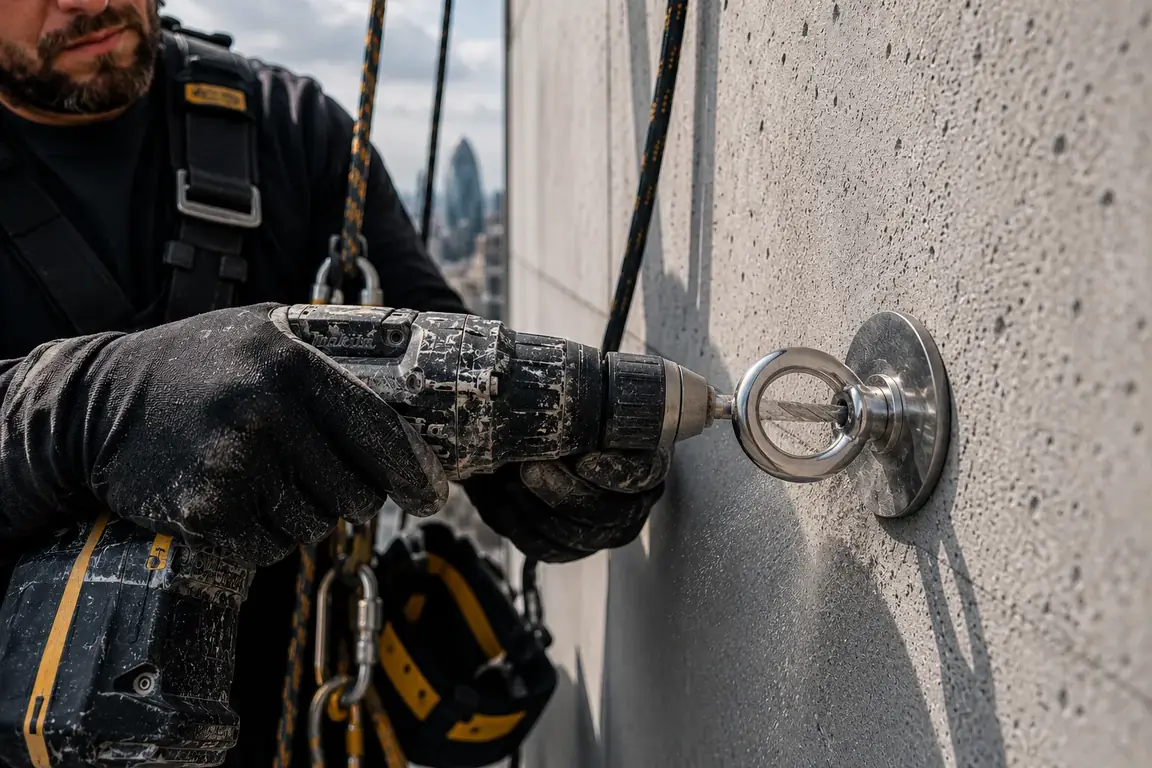
Eyebolts, brackets and similar devices are fixed into the structure at chosen points. They are common and flexible, and a good layout lets rope access technicians and others reach every area.
- Strengths: simple, adaptable, and well suited to rope access when positioned for the drops
- Watch for: the substrate and fixing method, corrosion, roof penetrations and their weatherproofing, and the inspection and test regime
- Fixing types: many are post-installed into concrete or masonry using mechanical or chemical (resin) fixings, which need correct installation and testing
Horizontal lifelines
A cable run between end posts and intermediate supports lets a person move along a route while staying connected. They are common on roofs where people work along edges.
- Strengths: continuous protection along a route, and good for repeated access
- Watch for: the load on end posts and the structure, the number of users the system is rated for, the effect of a fall on the cable, and clearance below
- They are engineered systems and must be designed for the building
Rigid rails
A rail fixed to the structure carries a runner that the user's lanyard clips to, so there is no gap in protection as they move.
- Strengths: smooth movement, high capacity and suitability for frequent use
- Watch for: cost, fixings into the structure, and the need for regular inspection of the rail, runner and supports
Deadweight anchors
Heavy devices placed on a flat roof that work by weight and friction instead of being fixed to the roof.
- Strengths: no penetrations, so no new waterproofing details
- Watch for: the roof's capacity to carry the weight, slip resistance on the roof surface, edge distance, and strict limits on how they are used
- They are not suitable everywhere, and an engineer's assessment is usually needed
Choosing a system
| Question | Why it matters |
|---|---|
| How will people move on the roof and down the façade? | Determines point anchors versus lines or rails |
| How many people will connect at once? | Systems have a rated number of users |
| What loads will be applied? | Rope access and fall arrest put different loads on anchors |
| What is the structure and roof build-up? | Decides fixings and whether the structure can carry loads |
| What roof covering is there, and who holds the warranty? | Penetrations need weatherproofing and may affect warranties |
| What is the layout and where are the edges? | Determines positions and clearances |
| Who will inspect and certify it? | Must be ongoing, and records kept |
A competent person should design the system for the building, often with a structural engineer for the loads and fixings.
Installation, testing and records
Whatever type is chosen:
- Design by a competent person to the relevant standards
- Install by competent people following the manufacturer's instructions
- Test at installation, for example by proof-loading post-installed anchors
- Document the layout, anchor details and test results
- Inspect at least every 12 months, as BS 7883 recommends, and after any event that could have damaged it
- Withdraw from use anything damaged or without records
Poor records are the most common problem, and a contractor may refuse to use an anchor system without them. See anchor point inspection.
Why it matters for access
Good anchor provision makes every future job safer, quicker and cheaper. Without it, contractors have to bring temporary arrangements or use more expensive methods. It also underpins rescue arrangements. See rope access rescue plans, work at height: the hierarchy of control and rope access vs BMU cradles.
Questions to ask
- What type of anchors do we have, and what are they rated for?
- When were they last inspected and tested?
- Where are the records and the layout drawing?
- Are the anchors suitable for rope access as well as other users?
- What happens to the roof warranty if we add or change anchors?
- Who is competent to design and install new ones?
FAQ
Which anchor type is best?
It depends on the building and the work. A competent person should design the system for how the building will be used.
Do deadweight anchors need testing?
They need inspection and assessment like any anchor. The system's limits and the roof's capacity must be understood.
Can we add anchors to an existing roof?
Often yes, with a design for the structure and attention to weatherproofing.
Who can install anchors?
Competent installers, following the manufacturer's instructions and relevant standards, with testing and records.
Talk to us
If you are not sure what anchors your building has, or want to install new ones, send us the address and any records you have. Read about our anchor installation and inspection service, or request a site survey.
Sources
- BS EN 795, Personal fall protection equipment: anchor devices. Check the current edition.
- BS 7883, Code of practice for the design, selection, installation, use and maintenance of anchor devices for harness-based work at height. Check the current edition.
- Manufacturer guidance for the anchor system installed.


