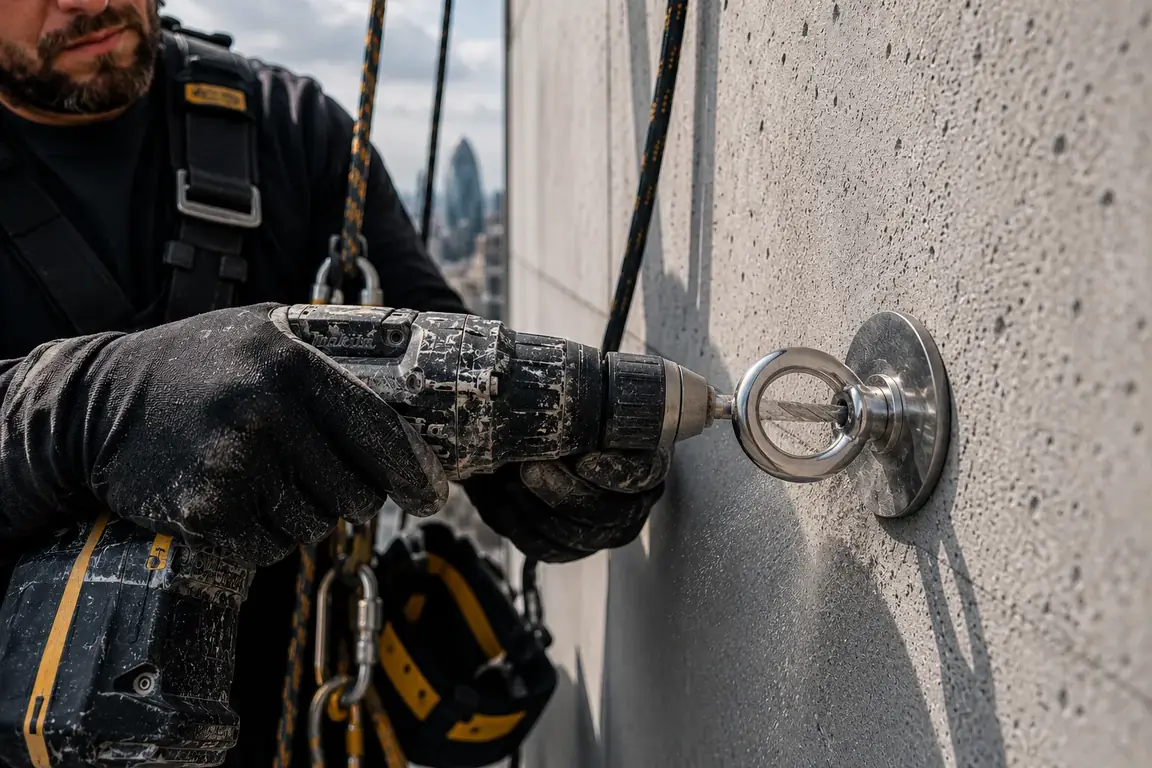
Quick answer: The Work at Height Regulations 2005 set out a hierarchy: first avoid working at height if you reasonably can, then prevent falls with suitable equipment where you cannot avoid it, and finally minimise the distance and consequences of a fall where you cannot eliminate the risk. Within that order, collective protection that protects everyone, such as guardrails, comes before personal protection, such as harnesses and ropes. Rope access is a recognised method for situations where other equipment is not reasonably practicable, for example on high or awkward façades and for short or specialist tasks, as long as the risk assessment shows it is the safest practicable way. As the person arranging the work, you should expect your contractor to explain why they have chosen their method.
The three steps
1. Avoid
Can the work be done without going up? Examples:
- doing the job from the ground with long-reach tools
- using a drone to inspect instead of sending someone up. See what drone inspections can and can't show
- designing out the need, for example by fitting permanent access, or cleaning from the inside
- combining tasks so fewer visits at height are needed
If the work genuinely cannot be avoided, move to the next step.
2. Prevent a fall
Use equipment that stops a fall happening:
- guardrails and edge protection
- scaffold with guardrails and platforms
- powered platforms (MEWPs) and other access equipment
- fixed walkways and platforms, and restraint systems that stop a person reaching an edge
This step puts collective measures first, because they protect everyone without relying on an individual doing the right thing.
3. Minimise the distance and consequences
Where a fall cannot be completely prevented, reduce the harm:
- fall arrest systems such as harnesses and lanyards, or safety nets
- work positioning and rope access systems, where workers are supported by ropes, with a back-up line
- rescue arrangements so that anyone who falls or becomes suspended can be brought down quickly
This is where personal protection sits. It relies on training, equipment and supervision.
The order within each step
| Principle | Meaning |
|---|---|
| Collective before personal | Guardrails and platforms before harnesses |
| Prevent before arrest | Stop the fall rather than catch it |
| Plan, supervise, and train | Competent people, with planned work and the right equipment |
| Rescue is part of the plan | Never rely on the emergency services alone. See rope access rescue plans |
Where rope access fits
Rope access is a work positioning technique. It does not sit above or below scaffold on a ladder of preference. HSE guidance recognises it where a risk assessment shows it is the safest practicable method, such as when:
- the work is short in duration, so erecting scaffold would be disproportionate
- the work is on high or awkward elevations that other equipment cannot reach safely
- the building layout, street or ground conditions make other methods impractical
- the task is specialist or scattered across the building
- speed and low disruption matter
Rope access relies on two separately anchored ropes, trained and assessed technicians, supervision and a rescue plan, as set out in the IRATA International Code of Practice. See IRATA certification explained.
It is not always the answer. For long programmes needing heavy materials at height, or large-scale repair on one elevation, scaffold may be the better choice. See rope access vs scaffolding and rope access vs MEWP.
What it means for you
As the building owner or manager, you are not expected to design the access. But you should:
- ask the contractor to explain why they have chosen their method and what alternatives they considered
- provide the information needed to plan safely, such as roof access, anchors and hazards. See site survey checklist
- check that planning has happened, through a risk assessment and method statement. See RAMS explained
- choose a competent contractor. See how to choose a rope access contractor
- avoid pushing for the cheapest method if it is not the safest
Questions to ask a contractor
- Could this work be avoided or reduced by another approach?
- Why is this method the safest practicable one here?
- What other methods did you consider, and why did you reject them?
- How will falling objects and the public be controlled?
- What are the rescue arrangements?
- Who is responsible for supervision on site?
FAQ
Does the law say rope access is a last resort?
The regulations require a hierarchy, and personal protection comes after collective. In practice rope access is used where it is the safest practicable method, and HSE guidance recognises its use. The risk assessment should show why.
Who is responsible for choosing the method?
The contractor, as the employer, is responsible for planning and carrying out the work safely. Building owners and managers have duties too, including providing information and appointing competent contractors.
What is the difference between restraint and arrest?
Restraint stops a person reaching a position where they could fall. Arrest catches them once they have fallen. Restraint is preferred.
Does this apply to short jobs?
Yes. The regulations apply to all work at height, however short.
Talk to us
If you are not sure which access method suits your building, send us the address and what you need. We will explain what we recommend and why, including when we think rope access is not the right choice. Read about rope access in London, or request a site survey.
Sources
- The Work at Height Regulations 2005 (legislation.gov.uk).
- HSE, work at height guidance, including its guidance on rope access.
- IRATA International, International Code of Practice for Industrial Rope Access (ICOP). Check the current edition.


