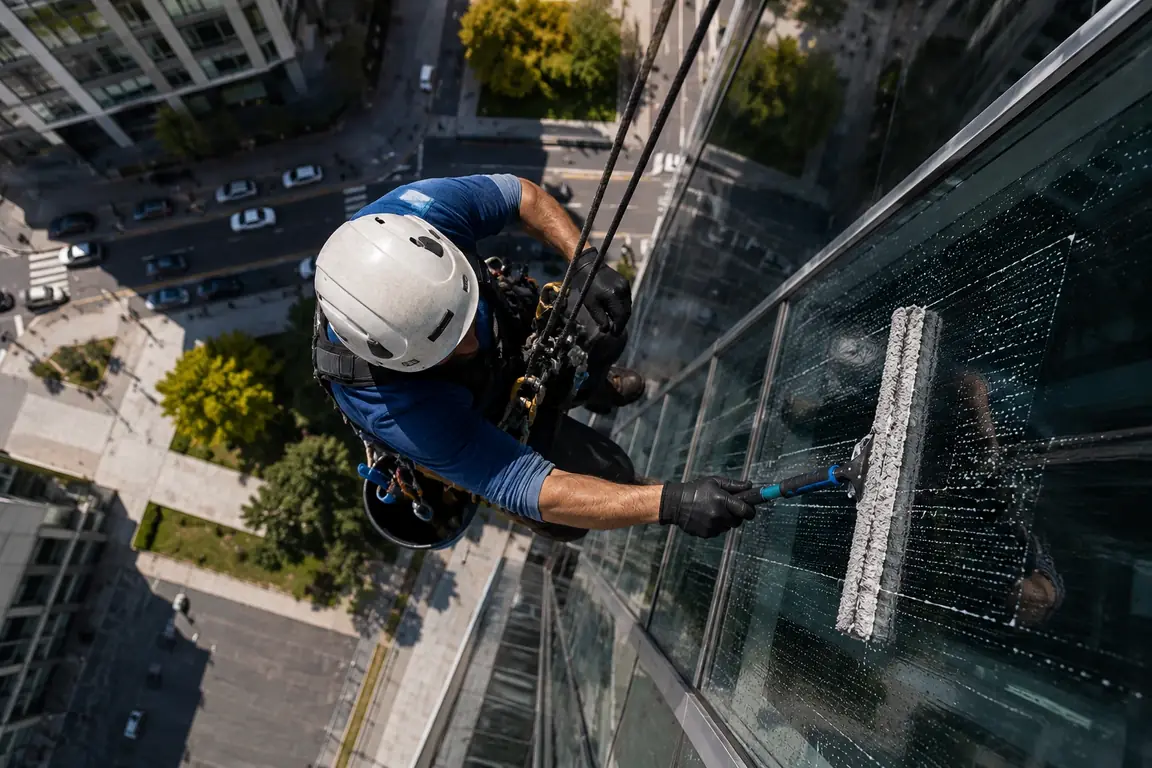
Quick answer: A building maintenance unit (BMU) is a permanent roof-mounted system that lowers a cradle (a suspended platform) down the façade. If your building has a working, certified BMU, it can be the efficient choice for regular cleaning of large, regular façades. But BMUs are expensive to own, need regular maintenance and statutory examination, and can be out of action. Rope access needs no permanent equipment, reaches areas a cradle cannot, and is often the sensible alternative or fallback. Many buildings use both: the BMU for routine cleaning, and rope access for inspection, repairs and anywhere the cradle cannot go.
What a BMU is
A BMU, sometimes called a gondola or cradle system, is permanently installed on or in the roof. It typically consists of a trolley or davit arm, a suspended cradle that carries people and tools, and winches and wire ropes that raise and lower it. Operators work from the cradle as it moves up and down the façade, sometimes along tracks or guide rails.
Temporary cradles (suspended platforms hired for a project) work on similar principles, but they are rigged for the job and then removed.
How they compare
| BMU or cradle | Rope access | |
|---|---|---|
| Equipment | Permanent installation on the building, or temporary hire | Ropes and personal equipment, brought by the team |
| Capital cost | High for a new installation | None |
| Ongoing cost | Maintenance, examination, operator training | Per job |
| Best for | Regular, large, uniform façades cleaned often | Varied tasks, awkward areas, one-offs and repairs |
| Reach | Limited to the cradle's travel and the façade shape | Can reach recesses, setbacks, atria and complex shapes |
| Load and tools | Can carry heavier tools and materials in the cradle | Limited to what technicians can carry and manage |
| Set-up | Quick if the BMU is working and in use | Quick for most jobs, rigged from the roof |
| When it breaks | The building has no access until it is repaired | Not affected |
| Statutory checks | Thorough examination required | Equipment inspection and anchor checks |
| Operators | Trained for the specific equipment | IRATA-certified technicians |
The inspection duties on a BMU
A BMU is lifting equipment that carries people, so it is subject to the Lifting Operations and Lifting Equipment Regulations 1998 (LOLER). In general:
- it must be thoroughly examined by a competent person at least every six months, or as set out in an examination scheme
- it needs regular maintenance and pre-use checks by operators
- it needs records of examinations, defects and repairs
- operators must be trained and competent, and rescue arrangements must exist
- the design and installation should follow the relevant standards, such as BS EN 1808 for suspended access equipment
If the paperwork is out of date, the BMU should not be used until it has been examined and found safe. Many building managers find the records are incomplete, so it is worth checking. For related duties on anchors and records, see anchor point inspection.
When a BMU is the right choice
- The building has a working, well-maintained BMU with current examinations
- The façade is large, regular and cleaned frequently
- The tasks need heavier tools or materials than a rope access team could carry
- You have the budget and processes to keep it maintained
- The cradle's reach covers most of the elevation
When rope access is the better choice
- The building has no BMU, and installing one would be uneconomic
- The BMU is broken, uncertified or out of service
- The façade has setbacks, projections or complex shapes the cradle cannot reach
- You need detailed inspection and hands-on repair
- The work is one-off, short or scattered
- You need quick access without a long set-up or a licence for temporary equipment
Our guide to high-rise window cleaning covers the comparison for cleaning, and rope access vs scaffolding and rope access vs MEWP look at other options.
Using both together
A common and efficient approach is:
- Use the BMU for routine cleaning of main elevations
- Use rope access for inspection, sealant, repairs, and areas the BMU cannot reach
- Use rope access as the fallback when the BMU is out of service
- Keep both sets of records up to date
What if our BMU is broken?
If a BMU is out of service, you still need to reach the façade. Options include:
- Rope access, if roof anchorage is available and certified, which is often the quickest fix
- A temporary cradle or platform, for larger projects
- Repair or replacement of the BMU, which can take time and money
Rope access depends on suitable anchor points, so check them. If none exist, a contractor can often install them. See fixed anchor systems compared.
Questions to ask
- Does our BMU have a current thorough examination and maintenance record?
- Who is trained to operate it, and who provides rescue?
- What areas can it not reach?
- What is the plan if it is out of service?
- Would rope access be better value for this job?
- Are our anchors certified, in case we need to use ropes?
FAQ
Is a BMU safer than rope access?
Neither is safe by default. Both are safe when planned, supervised, inspected and operated by competent people, and both have rescue arrangements.
Can rope access replace a BMU?
For many tasks, yes, but not always. Heavy loads or very regular, large-scale cleaning may suit a BMU.
How often must a BMU be examined?
Under LOLER, equipment that lifts people generally needs thorough examination at least every six months. Your competent person will confirm the scheme that applies.
Can we mix methods on one job?
Yes. Many projects do.
Talk to us
If your BMU is out of action, or you are deciding how to reach your façade, send us the address. We will say whether rope access suits it. Read about rope access in London and our façade cleaning service, or request a site survey.
Sources
- The Lifting Operations and Lifting Equipment Regulations 1998 (LOLER), and HSE guidance on lifting equipment.
- BS EN 1808, Safety requirements on suspended access equipment: design calculations, stability criteria, construction, tests. Check the current edition.
- The Work at Height Regulations 2005 (legislation.gov.uk).


