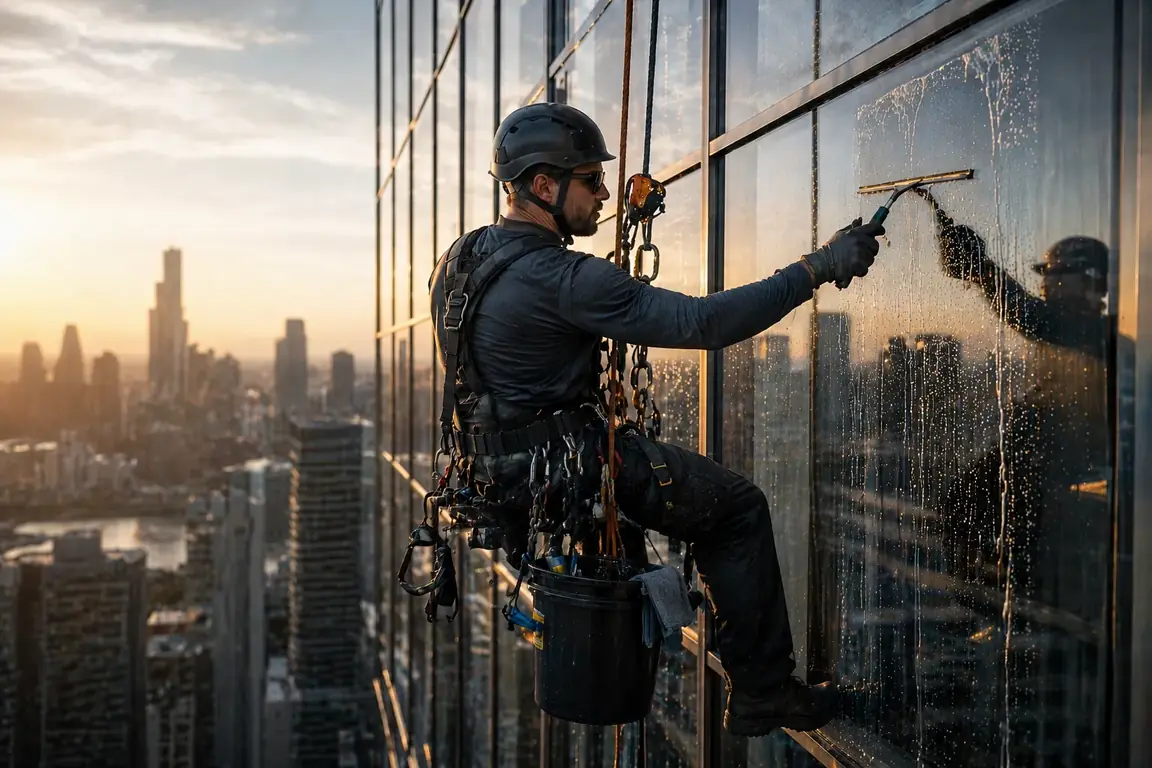
Quick answer: A rope access day follows a predictable pattern: arrival and sign-in, a safety briefing, equipment and anchor checks, rigging, an exclusion zone set up below, the work itself, regular weather and safety checks, tidy-up and handover. The team is normally at least two technicians with a Level 3 supervisor responsible for the site. As the building manager, you will be asked to provide access, confirm permits and give a contact, and then you mostly stay out of the way. Knowing what happens helps you plan around it and spot whether the team is working properly.
Before the day
By the time the team arrives, several things should already be in place:
- a site survey has been carried out, and the scope agreed. See site survey checklist
- a RAMS and rescue plan have been issued and reviewed. See RAMS explained
- any permit to work is arranged. See permit to work explained
- tenants and neighbours have been told. See tenant notice template
- anchors, keys and access are arranged
- the weather forecast has been checked
If any of these are missing on the day, expect a delay.
A typical day, step by step
| Stage | What happens |
|---|---|
| 1. Arrival and sign-in | The team arrives, signs in, and meets your contact. They show certificates and the permit if needed |
| 2. Site briefing | The supervisor briefs everyone on the plan, hazards, exclusion zones, emergency arrangements and roles |
| 3. Walk-through | The team checks the roof, edges, anchors and the area below, and confirms nothing has changed |
| 4. Equipment checks | Ropes, harnesses and tools are inspected before use, and recorded |
| 5. Exclusion zone | The area below is cordoned off and signed. See public safety during façade work |
| 6. Rigging | Ropes are attached to certified anchors or suitable points, with a working line and a back-up line for each technician |
| 7. Rigging check | A second person checks the rigging before anyone goes over the edge |
| 8. The work | Technicians descend and carry out the task, with tools secured and materials controlled |
| 9. Monitoring | The supervisor watches the weather, the team and the zone below, and stops work if needed |
| 10. Breaks and welfare | The team takes planned breaks, and anyone who needs help is brought down safely |
| 11. End of work | Technicians come down, equipment is de-rigged and the roof is left tidy |
| 12. Clear-up and handover | Debris is removed, the cordon is taken down and the supervisor reports to your contact |
Who does what
| Role | Responsibility |
|---|---|
| Level 3 supervisor | Responsible for the site, the plan, safety checks and rescue readiness. Decides when to stop |
| Technicians | Carry out the work, keep to the method, and look after each other |
| Ground support or banksman | Where needed, controls the area below and pedestrians |
| Your contact | Provides access, answers questions, and is told about anything unusual |
What the team will ask of you
- Roof access: keys, codes or someone to let them in
- A named contact on site, and a phone number
- Permission to use the facilities the plan allows, such as welfare and storage
- Information about anything that has changed since the survey
- Notice of any emergencies or events in the building that day
What you should see
A well-run rope access job looks calm and organised. Look for:
- a briefing before work starts
- ropes in pairs for each technician
- tools tied off, and no loose items on the roof edge
- a marked and managed exclusion zone
- equipment that looks clean and well-kept
- a supervisor who is visibly in charge
- tidy working areas and prompt clearing up
Things that should worry you:
- no briefing or paperwork, or the wrong team
- one rope on its own for a person
- people working alone on the roof or at the edge
- no exclusion zone or a poorly managed one
- materials left on the roof edge
- the work continuing in high wind or storm conditions
If you are concerned, speak to the supervisor straight away. You are entitled to raise it.
Weather and delays
Weather can stop work. High winds, heavy rain, ice and lightning are common reasons, and the supervisor makes the call. A day lost to weather is normal, so a good programme includes some slack. See wind and weather limits for work at height.
Noise, dust and mess
Depending on the task, there may be noise from drilling, dust from preparation, or water from cleaning. The method statement should say how these will be controlled, and waste should be collected, not dropped. If timing is an issue, see out-of-hours façade work.
Handover
At the end, the supervisor should give you:
- confirmation that the work is complete and the area is safe
- a summary of what was done and anything found
- photographs where agreed
- details of any follow-up work needed
- a written record within the time agreed
Keep these records. They feed into your maintenance history. See planned façade maintenance.
FAQ
How long does a rope access job take?
It depends on the scope, the number of drops and the weather. The contractor should give you a programme.
How many people will be on site?
Normally at least two technicians, with a Level 3 supervisor. Larger jobs have bigger teams.
Do I need to be there all day?
Not usually, but your contact should be reachable, and available at the start and end.
What if the weather is bad?
Work stops until it is safe, and the programme is adjusted.
Talk to us
If you would like to know what a job on your building would look like, ask us at the survey and we will explain it. Read about rope access in London, or request a site survey.
Sources
- IRATA International, International Code of Practice for Industrial Rope Access (ICOP). Check the current edition.
- The Work at Height Regulations 2005 (legislation.gov.uk).
- HSE, work at height guidance, including its guidance on rope access.


