Quick answer: The tops of walls and the junctions where roofs meet walls are where many leaks start. Copings cap the top of a parapet, flashings seal the junction between the roof covering and a wall or upstand, and parapet walls can soak up water from above if the capping fails. Typical faults are open joints between coping stones, lifted or cracked flashings, failed sealant, missing drip details and blocked outlets. Staining or damp below a parapet is often the first clue. Look at these details at least annually and after storms. They are small, high up and easy to miss from the ground.
What these parts do
| Part | Role |
|---|---|
| Parapet | A low wall at the edge of a roof, which protects the edge and hides the roof |
| Coping | The capping on top of a parapet. It sheds rain away from the wall below |
| Flashing | A strip, often lead or metal, that seals where a roof meets a wall, upstand or penetration |
| Upstand | The part of the roof covering that turns up against a wall |
| Drip | A groove or overhang that throws water clear of the wall face |
| Parapet gutter | A gutter running behind a parapet, which needs clear outlets |
Water that gets past any of these can run down inside the wall and appear as damp, staining or efflorescence far below.
Common defects
| Defect | What happens |
|---|---|
| Open joints between coping stones or units | Water runs straight into the wall below |
| Cracked, loose or displaced copings | Gaps and lost shedding of water |
| Missing or ineffective drip details | Water runs back under the coping and down the wall face |
| Lifted, cracked or split flashings | Open junction between roof and wall |
| Failed or missing mortar and sealant at flashing chases | Water enters behind the flashing |
| Poorly fixed or poorly detailed lead | Movement, tearing and gaps |
| Cracked or loose chimneys, stacks and pots | Water entry and falling debris |
| Blocked parapet gutters and outlets | Overflow into the wall or building |
| Vegetation growing in joints | Roots opening joints. See algae, moss and biological growth |
What staining and damp tell you
| What you see | What it may indicate |
|---|---|
| Dark streaks below a parapet | Water running over the face from a failed coping or drip |
| Damp or salt deposits on the wall below the roof edge | Water getting into the wall. See efflorescence |
| Stains on ceilings at the top floor | A leak at the roof edge or flashing |
| Staining around chimneys or roof penetrations | A failed flashing |
| Loose or hollow render or brick at the top of the wall | Long-term water entry |
If you already have a leak, the cause may be here, but it needs checking. See façade leak investigation.
How an inspection works
A careful inspection looks at each detail along the full length of the roof edge:
- Copings: joints, cracks, movement, drips and bedding
- Flashings: fixing, laps, cracks, gaps, corrosion and chase sealing
- Parapet walls: pointing, cracks, moisture and structural condition
- Parapet gutters and outlets: debris, falls and overflows
- Chimneys and stacks: pointing, flaunching and flashings
- Anchors and edge protection: their condition, because the same area is used for access. See anchor point inspection
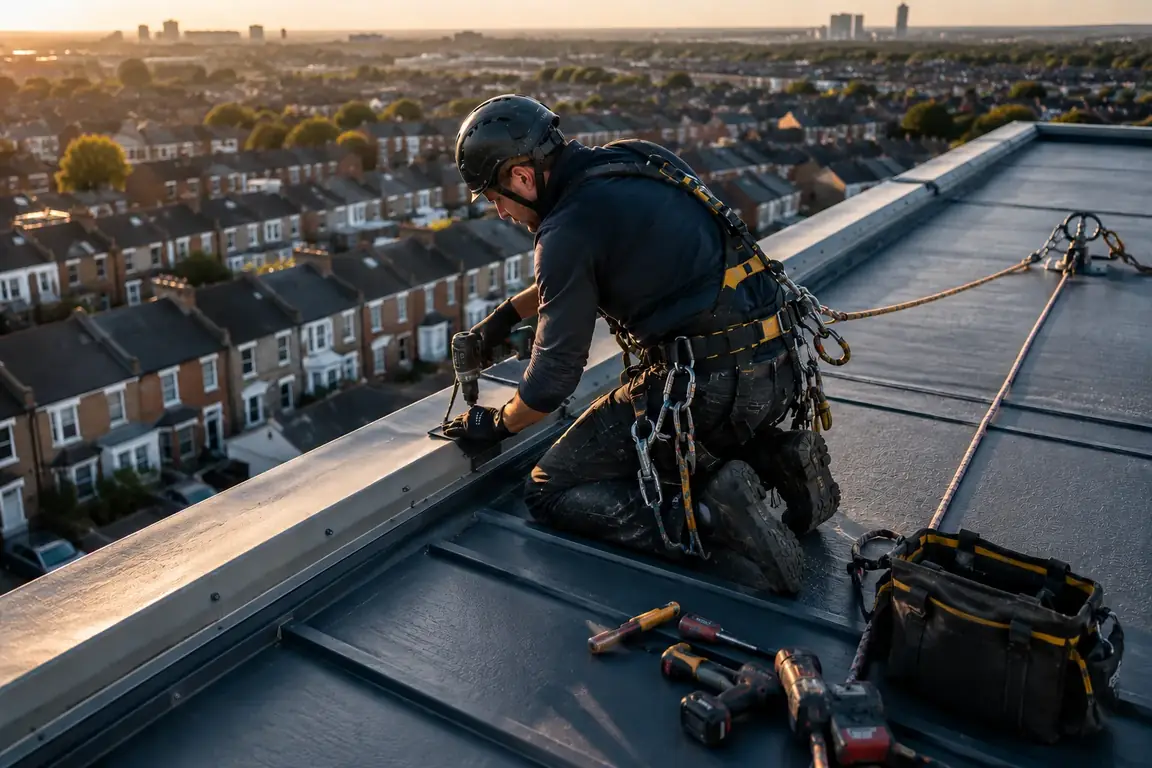
A drone can screen the whole roof edge quickly, and a hands-on inspection from rope access can look closely at the details that need it, check the joints by hand and photograph each one. See what drone inspections can and can't show.
Repair options
| Problem | Typical repair |
|---|---|
| Open coping joints | Re-point or re-seal with a suitable product, or replace failed units |
| Cracked or displaced coping | Re-bed or replace |
| Failed flashing | Re-dress, repair or renew, with proper fixings and details |
| Failed flashing chase sealing | Re-point or re-seal |
| Missing drips | Add a suitable drip or replace the coping |
| Blocked outlets | Clear and check falls. See gutter clearance |
| Vegetation | Remove, treat and repair the joints |
Lead flashings need proper detailing and fixing to allow for movement. Repairs that ignore this can fail quickly. Ask whether the work follows industry guidance for the material.
Why details matter more than materials
A good coping in the wrong detail leaks. A single open joint in a parapet can send water into a wall for years before it is visible. Fixing these details early is among the cheapest repairs a building can have, compared with the damage when they are ignored. They fit naturally into a planned façade maintenance programme.
Safety
Roof edges are dangerous. Anyone working on parapets and flashings needs safe access, edge protection or rope access, and a plan. See roof inspections and safe access and rope access vs scaffolding.
A checklist for annual inspection
- Are all coping joints closed and sealed?
- Are any copings loose, cracked or displaced?
- Are drips present and working?
- Are flashings secure, intact and sealed at their upper edges?
- Are parapet gutters and outlets clear?
- Is there staining or damp below the roof edge?
- Are there plants growing in joints?
- Are chimneys and stacks sound?
FAQ
Why do parapets leak so often?
They are exposed on all sides, and any open joint in the coping lets water into the wall. The water can travel a long way before it shows.
Can I just seal the coping joints?
Sealant can help where it is the right repair, but the coping may need re-bedding or replacing, and the drip detail matters. Have it inspected first.
How often should they be checked?
At least annually, and after storms.
Is lead flashing a DIY job?
No. It needs the right fixing, laps and allowance for movement, and it is at height. Use competent people.
Talk to us
Send us photographs of any staining below your roof edge and the building address. We can look at the copings and flashings from above and tell you what we find. Read about our roof repairs and inspection and waterproofing services, or request a site survey.
Sources
- Lead Sheet Association guidance on lead roofing and flashings.
- BS 6229, Flat roofs with continuously supported coverings: code of practice. Check the current edition.
- Manufacturer guidance for coping and flashing systems.


